A USP Purified Water system must meet two chemical limits, conductivity ≤1.3 µS/cm at 25°C and TOC ≤500 ppb, and be proven through DQ, IQ, OQ and PQ documentation. USFDA auditors check both: the water quality data, and the validation trail showing the system consistently produces it.
Purified Water (PW) is the most widely used pharmaceutical water grade, used in formulation, equipment washing and as feedwater for Water for Injection (WFI) systems. The framework sits in USP <1231>, USFDA 21 CFR Part 211, WHO GMP guidance on water for pharmaceutical use (TRS 1033, Annex 3) and, for API manufacturers, ICH Q7.
What are the USP limits for Purified Water?
Purified Water must meet conductivity ≤1.3 µS/cm at 25°C, tested by USP <645>, and TOC ≤500 ppb, tested by USP <643>. USP <1231> recommends a microbial action level of 100 CFU/mL. PW has no endotoxin specification; Water for Injection adds an endotoxin limit of 0.25 EU/mL.
| Parameter | Purified Water | Water for Injection | Reference |
|---|---|---|---|
| Conductivity | ≤1.3 µS/cm at 25°C (Stage 1) | ≤1.3 µS/cm at 25°C (Stage 1) | USP <645> |
| TOC | ≤500 ppb | ≤500 ppb | USP <643> |
| Microbial | 100 CFU/mL action level | 10 CFU/100 mL action level | USP <1231> guidance |
| Endotoxin | Not specified | 0.25 EU/mL | USP <85> |
| Production | Any suitable process: RO, EDI, ion exchange | Distillation or an equivalent or superior process | USP monographs |
The 1.3 µS/cm figure is the Stage 1 limit in USP <645>, applied to uncompensated conductivity against a temperature table. A sample that fails Stage 1 can go to Stages 2 and 3, which are laboratory tests on an air-equilibrated sample with a pH check, before a result is declared out of specification. The microbial figures are action levels in general guidance, not monograph limits, so your own alert and action levels must be set and justified from trend data.
What treatment train produces USP Purified Water?
Municipal and groundwater supplies typically carry 500–3,000 mg/L TDS, so a PW system runs pretreatment, double-pass RO and EDI polishing. Navbharat Water's double-pass RO plus EDI systems deliver conductivity below 0.1 µS/cm, well inside the 1.3 µS/cm limit; a 50 KLD system in Hyderabad produces 0.06 µS/cm.
- Pretreatment: multimedia filtration, softening and activated carbon or SMBS dosing to remove turbidity, hardness and chlorine that would damage RO membranes.
- First-pass RO: permeate at 10–500 µS/cm depending on feed quality.
- Second-pass RO and EDI: bring conductivity below 0.1 µS/cm without regenerant chemicals.
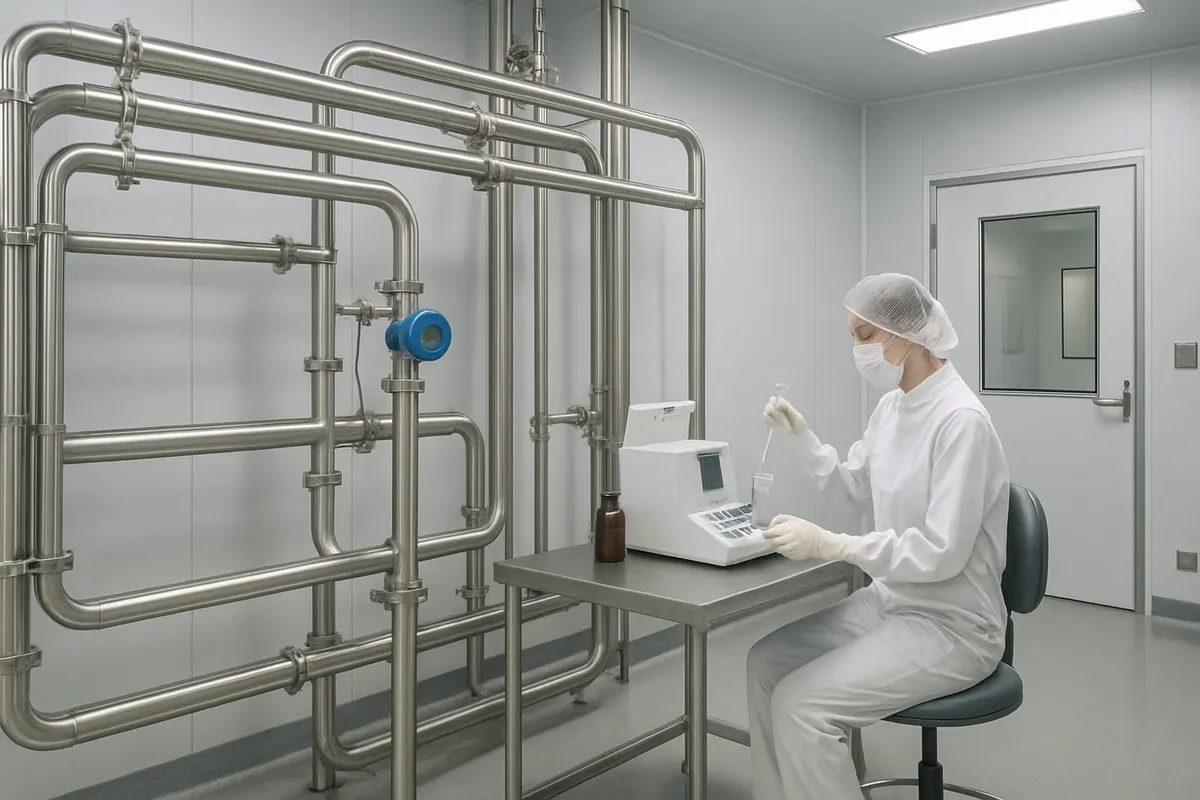
- Storage and distribution loop: SS 316L, sloped at least 1% for drainability, with spray balls and vent filters, and designed to avoid dead legs.
- Online monitoring: TOC and conductivity analysers with a 21 CFR Part 11 audit trail.
Designing close to the limit is a false economy. Feedwater changes with the season and membranes age, so the margin between 0.1 µS/cm and 1.3 µS/cm is what keeps the system in specification over years rather than months.
What goes into the URS and Design Qualification?
The User Requirements Specification states what the plant needs, for example a defined daily volume and peak draw of PW at conductivity tighter than the 1.3 µS/cm limit. Design Qualification documents that the proposed design meets every URS requirement. Auditors expect each URS line to trace to a design feature and later to an IQ, OQ or PQ test.
A DQ package normally covers:
- P&IDs, process description and design basis, including feedwater analysis.
- Materials of construction and surface finish for wetted parts.
- Distribution loop design: velocities, slopes, dead-leg avoidance and points of use.
- Sanitisation method and frequency.
- Instrument list with ranges and calibration requirements.
- Control system description, including how electronic records meet Part 11.
- A risk assessment linking each hazard to a design control.
What do IQ and OQ prove?
IQ proves the system was installed as designed: materials, welds, slopes, instruments and drawings match the approved design. OQ proves each function operates within its design limits, including alarms and interlocks. On a typical 5–50 KLD system, Navbharat Water reaches IQ completion 12–16 weeks from order.
| Stage | Question it answers | Typical evidence |
|---|---|---|
| DQ | Does the design meet the URS? | Design review, traceability matrix, risk assessment |
| IQ | Was it installed as designed? | As-built P&IDs, material certificates, weld records, slope checks, NABL-traceable calibration certificates |
| OQ | Does it operate within design limits? | Alarm and interlock tests, flow and pressure tests, sanitisation cycle tests, control system challenge tests |
| PQ | Does it consistently produce specification water in routine use? | Sampling at every point of use, trend data, deviation log |
How long does Performance Qualification take?
PQ is normally run in phases. Navbharat Water's standard schedule includes an intensive 21-day continuous monitoring period after IQ and OQ, which brings a typical project to validated operation in 5–6 months. Monitoring then continues across a full year, so seasonal changes in feedwater quality are captured in the data.
The widely used three-phase approach works as follows:
- Phase 1: intensive sampling at every point of use and at key process stages while operating and sanitisation procedures are finalised; water is not released for production.
- Phase 2: continued intensive sampling under the finalised procedures, demonstrating consistent performance.
- Phase 3: routine monitoring over a year, confirming performance through seasonal variation and establishing the long-term trend used for alert and action levels.
What does 21 CFR Part 11 mean for a water system?
Part 11 governs electronic records and signatures. If online TOC and conductivity data are used as GMP records, the system needs individual user access, audit trails recording who changed what and when, and protection against data alteration. Navbharat Water configures online TOC and conductivity monitoring with a Part 11 audit trail.
Part 11 sits alongside Part 211, the cGMP regulation for finished pharmaceuticals, which requires that water systems are validated and controlled. Auditors increasingly assess data integrity against the ALCOA principles: records must be attributable, legible, contemporaneous, original and accurate. Shared passwords, disabled audit trails and data exported to uncontrolled spreadsheets are typical gaps.
What causes audit observations on PW systems?
Most observations, including those recorded on a USFDA Form 483, trace back to gaps between the documents and the plant. The Hyderabad 50 KLD system Navbharat Water built has run three years with zero out-of-specification incidents and TOC consistently below 100 ppb, with the qualification trail matching the installed system.
- Modifications made without change control or requalification.
- Excursions closed without a documented root cause investigation.
- Alert and action levels not defined, or defined but not trended.
- Instruments past their calibration date.
- Dead legs or stagnant sections in the distribution loop.
- Sanitisation frequency not supported by validation data.
Navbharat Water designs, builds and validates USP Purified Water systems with full DQ, IQ, OQ and PQ documentation as part of its Healthcare and Pharma offering (/industries/healthcare-pharma), with the underlying double-pass RO and EDI technology described under Membrane Systems (/solutions/membrane-systems).
Frequently asked questions
Can an existing industrial RO plant be upgraded to USP Purified Water?
In most cases, yes. The key additions are a pharmaceutical-grade storage and distribution loop in SS 316L with a slope of at least 1%, spray balls and vent filters, an EDI polishing module, and online TOC and conductivity monitoring with a 21 CFR Part 11 audit trail. The existing RO must be assessed first.
What conductivity should a PW system be designed for?
The USP limit is 1.3 µS/cm at 25°C, but designing close to it leaves no margin for seasonal feedwater changes or membrane ageing. Navbharat Water designs double-pass RO with EDI for conductivity below 0.1 µS/cm. The 50 KLD Hyderabad system delivers 0.06 µS/cm, roughly one-twentieth of the limit.
Does Purified Water need endotoxin testing?
USP sets no endotoxin specification for Purified Water. Water for Injection, used for parenteral products, carries an endotoxin limit of 0.25 EU/mL. If your PW system feeds a WFI generator, or your product risk assessment calls for it, endotoxin monitoring on PW can still be justified as part of the control strategy.
How long does it take to commission and validate a PW system?
A typical 5–50 KLD USP Purified Water system takes 12–16 weeks from order to IQ completion. OQ and an intensive 21-day PQ monitoring period follow, bringing total time to validated operation to 5–6 months. Routine PQ monitoring then continues through the first year of operation.
What validation documents does Navbharat Water provide?
Navbharat Water provides complete Design, Installation, Operational and Performance Qualification documentation, with all instruments calibrated to NABL-traceable certificates. The package is suitable for USFDA, WHO-GMP and EU-GMP audits, and is built into the project from the design stage so the qualification trail matches the installed system.
Sources
Ready to discuss your ZLD requirement?
Navbharat Water engineers have commissioned ZLD plants from 10 KLD to 10 MLD across India. Tell us your inlet profile and compliance target.
Request a Technical Audit