Key Questions
What is a ZLD plant and how does it work?
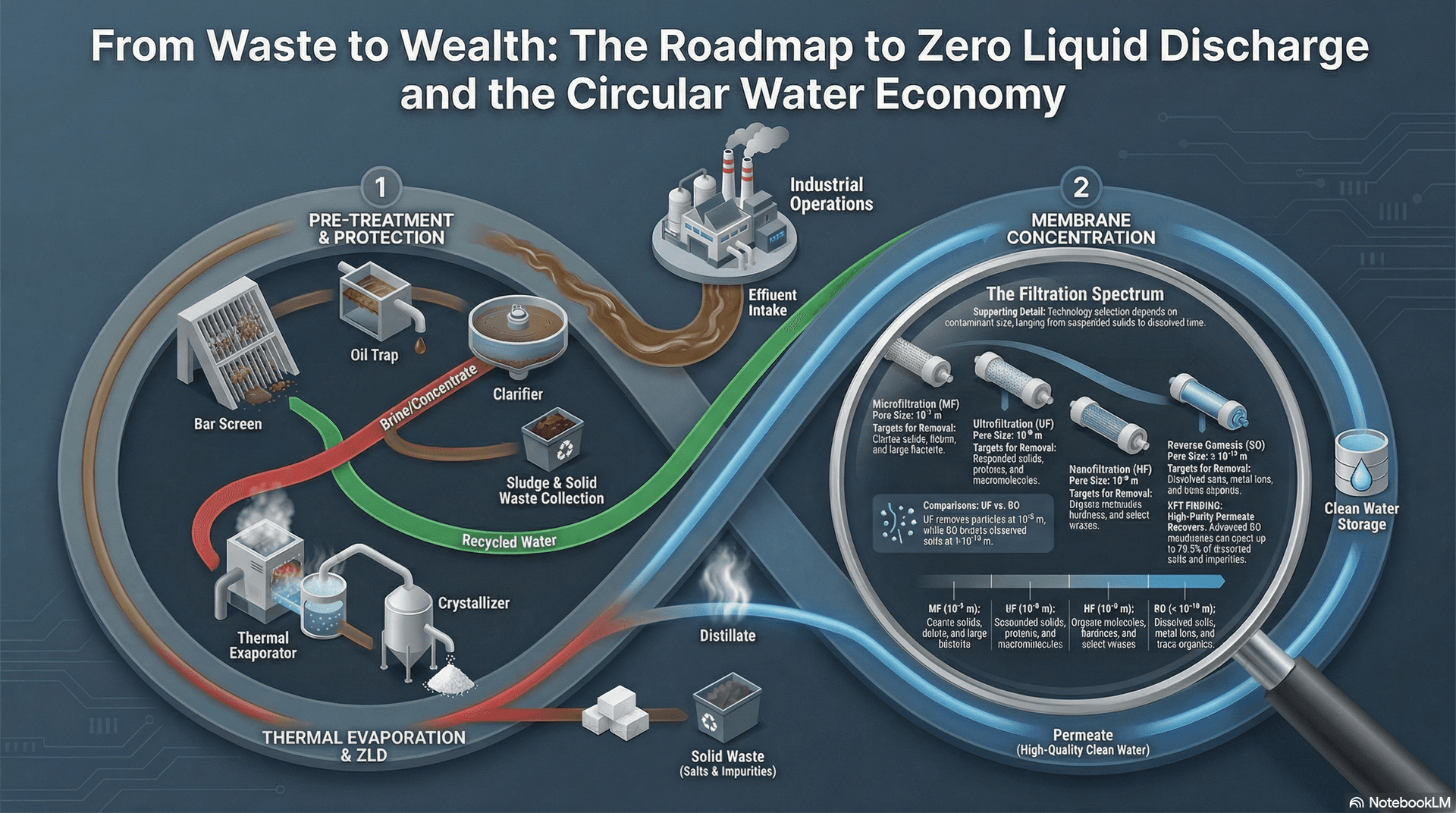
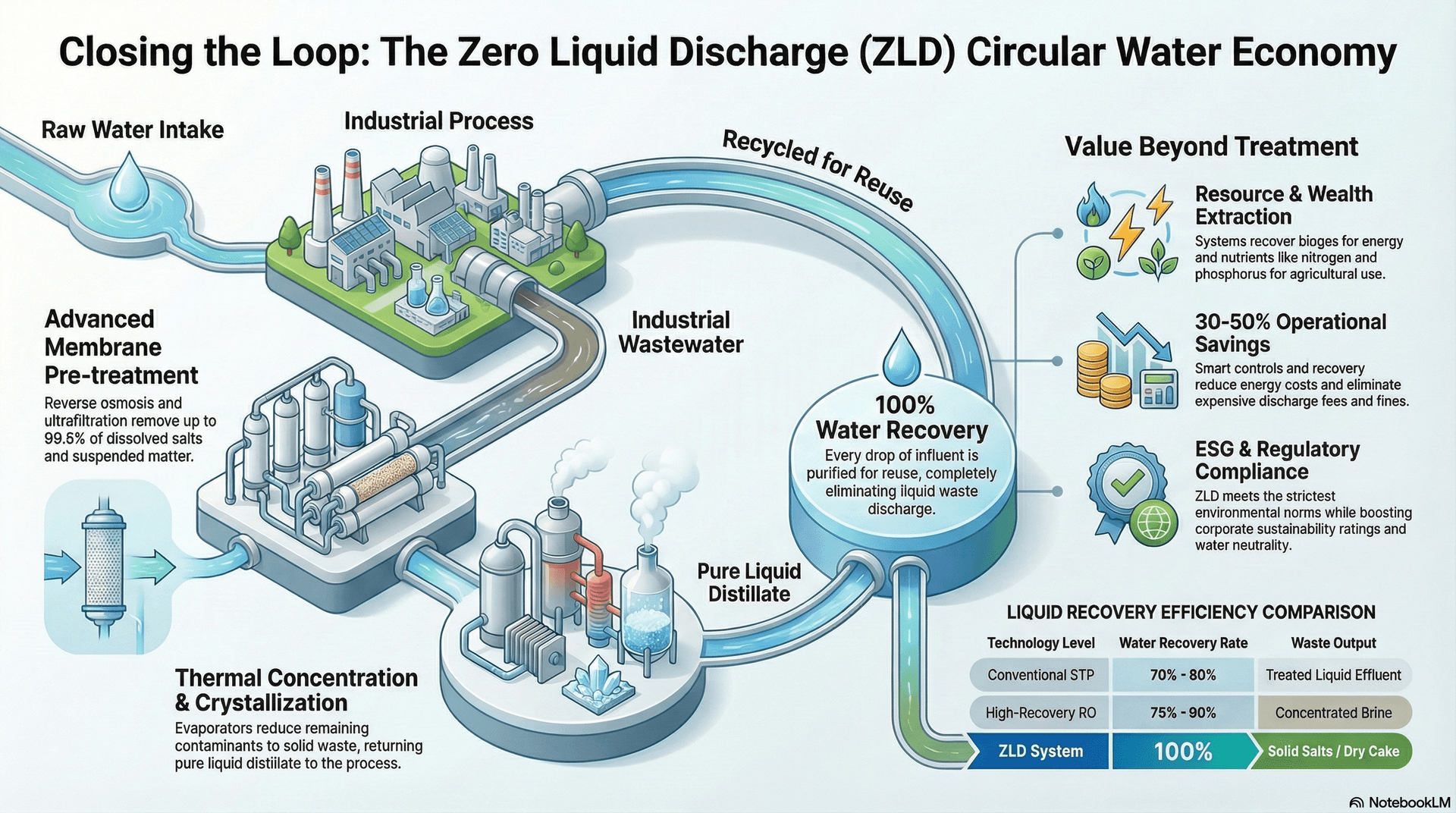
A Zero Liquid Discharge (ZLD) plant treats industrial effluent so that no liquid leaves the site. It chains ETP pre-treatment, reverse osmosis concentration and MEE or ATFD evaporation, recovering 95–99% of the water for reuse and converting what remains into dry, recoverable salt.
ZLD is not a single technology. It is a sequenced treatment train in which each stage concentrates the waste further. First, biological and chemical ETP treatment removes BOD, COD and suspended solids to bring the effluent to RO-feed quality. Second, high-pressure RO membranes operating at 15–80 bar split the stream into permeate, typically 70–80% of the feed, which returns directly to the process, and a brine concentrate. Third, a Multiple Effect Evaporator (MEE) or Agitated Thin Film Dryer (ATFD) thermally concentrates that brine until only dry salt remains. Navbharat Water builds ZLD plants from 10 KLD to 10 MLD for feed TDS between 2,000 and 80,000 mg/L. Power consumption runs 8–18 kWh/m³, highest for MEE-based systems and lowest for RO-only configurations, and ATFD salt purity of 98% or more allows sodium sulphate or sodium chloride recovery.
Which industries must install Zero Liquid Discharge in India?
Under CPCB directions and State Pollution Control Board orders, designated industries must implement ZLD. In practice this covers textile clusters, pharmaceutical manufacturers and industrial estates across 17 states, with red-category industries also bound by SPCB consent conditions.
Non-compliance is not a paperwork risk. Designated industries that fail to implement ZLD face closure orders, environmental compensation and criminal liability under the Environment Protection Act, 1986. The National Green Tribunal (NGT) compliance framework adds a further layer of enforcement, and SPCB consent conditions for red-category industries apply on top of central rules. Textile units are the most exposed sector: dyeing, printing and bleaching units in notified clusters such as Tirupur, Surat, Panipat and Ludhiana must achieve ZLD. Navbharat Water designs each installation to satisfy both central and state PCB requirements at once, and aligns systems with the ISO 14001 Environmental Management System. Companies that invest early also cut freshwater dependence: the average saving in freshwater costs for a 1 MLD ZLD plant is ₹2–5 Cr per year, which turns a regulatory obligation into an operating advantage.
How long does it take to build a ZLD plant, and can an existing ETP be upgraded?
A standard 500 KLD ZLD plant takes 5–6 months from order to operational compliance. Existing ETPs can usually be upgraded instead: adding RO concentration and an evaporation stage as a bolt-on retrofit typically costs 30–40% less than building a greenfield ZLD plant.
For a greenfield 500 KLD system, design takes 4–6 weeks, fabrication 10–14 weeks, civil work 6–8 weeks running in parallel, and commissioning 2–3 weeks. A retrofit starts with an assessment of the existing ETP treatment train to identify where RO concentration can be integrated, after which the evaporation stage is added. Footprint matters for planning: a 500 KLD plant needs roughly 800–1,200 m². For smaller units, the economics change. Below 50 KLD, capital cost per unit volume is high, so Navbharat Water recommends shared ZLD infrastructure for small clusters or a Tank Exchange rental model, where Navbharat Water owns the ZLD equipment and charges a treatment fee per kilolitre, removing upfront CAPEX entirely. In a 2 MLD textile cluster project in Surat, Gujarat, the plant achieved 99.2% water recovery and cleared PCB inspection without conditions.