Key Questions
Why is textile effluent so difficult to treat?
Textile effluent combines high COD, intense colour, high TDS and heat. Reactive dye effluent can carry up to 5,000 Hazen units of colour, TDS from dyeing and finishing baths can reach 15,000–30,000 mg/L, and effluent temperatures from hot dyeing baths can reach 60°C, which damages conventional biological treatment.
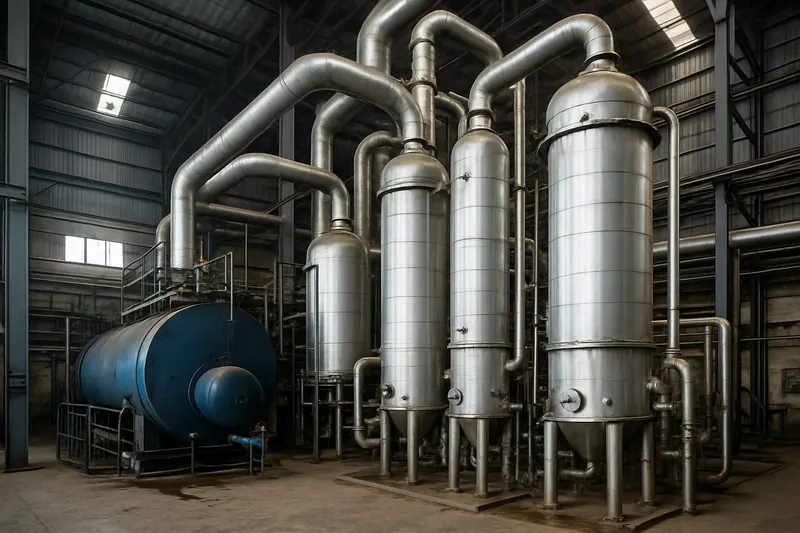
Each property defeats a different part of a conventional ETP. Colour from reactive dyes cannot be removed by biological treatment alone, so a polishing step using advanced oxidation or ozonation is needed. TDS of 15,000–30,000 mg/L is the highest load of any Indian industrial sector and demands high-pressure RO and MEE stages. Hot dyeing baths at up to 60°C can damage biological systems, which makes heat recovery and temperature management critical design parameters. Spinning and weaving facilities add another stream: wash water high in BOD and TSS that requires independent treatment or careful blending management. Navbharat Water designs textile systems around these streams individually. At a 500 KLD dyeing ETP in Tirupur, ozone treatment reduced outlet colour from 3,800 to 280 Hazen units, meeting TNPCB consent conditions, and recovered water reuse in the process offset 60% of ozone generation cost.
Is ZLD mandatory for textile units in India?
Yes, for units in notified clusters. CPCB directions, State Pollution Control Board orders and NGT orders require zero liquid discharge from all dyeing, printing and bleaching units in notified textile clusters such as Tirupur, Surat, Panipat and Ludhiana. Non-compliance carries closure orders and environmental compensation liability.
Enforcement is real: NGT orders between 2022 and 2024 imposed closure on units in the Tirupur, Surat and Ludhiana clusters. Beyond ZLD, textile units must meet CPCB general standards of BOD 30 or less, COD 250 or less and colour of 400 Hazen units or less for any discharge, along with sector-specific consent conditions from GPCB in Gujarat, MPCB in Maharashtra and TNPCB in Tamil Nadu. Grossly Polluting Industries must also run online continuous effluent monitoring under the CPCB OCEMS mandate. Navbharat Water covers the full chain: an ETP, RO and MEE or ATFD train that is CPCB-compliant with 95–99% water recovery and salt recovery for commercial resale, plus OCEMS sensors connected to CPCB CEMS for automatic compliance reporting. Its smart platform already manages 12 textile plants simultaneously, so compliance data for a whole group can be reviewed in one place.
How much does a textile ZLD plant cost?
For a 500 KLD dyeing unit, total ZLD CAPEX is typically ₹3.5–6 Cr, covering ETP pre-treatment, RO concentration, MEE and ATFD. Operating cost for power and chemicals runs ₹18–25 per kilolitre, and payback from freshwater savings is typically 4–7 years for textile units of this size.
The capital cost breaks down by stage: ETP pre-treatment at ₹80 lakh–1.2 Cr, RO concentration at ₹60–90 lakh, MEE at ₹1.8–2.5 Cr and ATFD at ₹80 lakh–1.2 Cr. The thermal evaporation stages account for the largest share. Two routes reduce the burden. First, recovered water and salt have value: at a 2 MLD textile ZLD plant in Surat, Gujarat, Navbharat Water achieved 99.2% water recovery, the client cut freshwater costs by ₹1.8 Cr a year, and dry salt sold at ₹4 per kg. The plant cleared PCB inspection without conditions. Second, small and mid-size units can avoid CAPEX entirely through the BOOT model, in which Navbharat Water finances, builds and operates the ZLD plant and the unit pays per kilolitre treated. Navbharat Water serves the Surat, Tirupur, Ludhiana and Bhilwara textile clusters with both conventional CAPEX and zero-CAPEX service models.