
Membrane Systems

Industrial RO, UF & NF Membrane Systems Manufacturer

Ultra-pure water. Precisely engineered at the molecular level.

Technically reviewed by Prashant Dwivedi, Co-Founder & Director ·

Membrane Systems · Live Process

The Challenge

Why can't municipal water meet pharmaceutical, data centre, and food-grade process requirements?

Pharmaceutical manufacturers require USP-grade purified water (PW) and water for injection (WFI). Data centers need ultra-low conductivity cooling water to prevent corrosion. Food processors need water free of pathogens and chemical residues. Standard municipal or groundwater supply — with TDS of 500–3,000 mg/L — cannot meet these demands without advanced membrane treatment.

< 1 µS/cm

Conductivity achievable with Navbharat Water's double-pass RO + EDI systems for pharma PW

Key Questions

What is a membrane water treatment system?

A membrane system forces water through semipermeable membranes that reject salts, bacteria and particles. Navbharat Water combines RO, UF, NF and MF membranes in systems from 1 KLD to 5 MLD, and reverse osmosis alone rejects more than 98% of dissolved TDS.

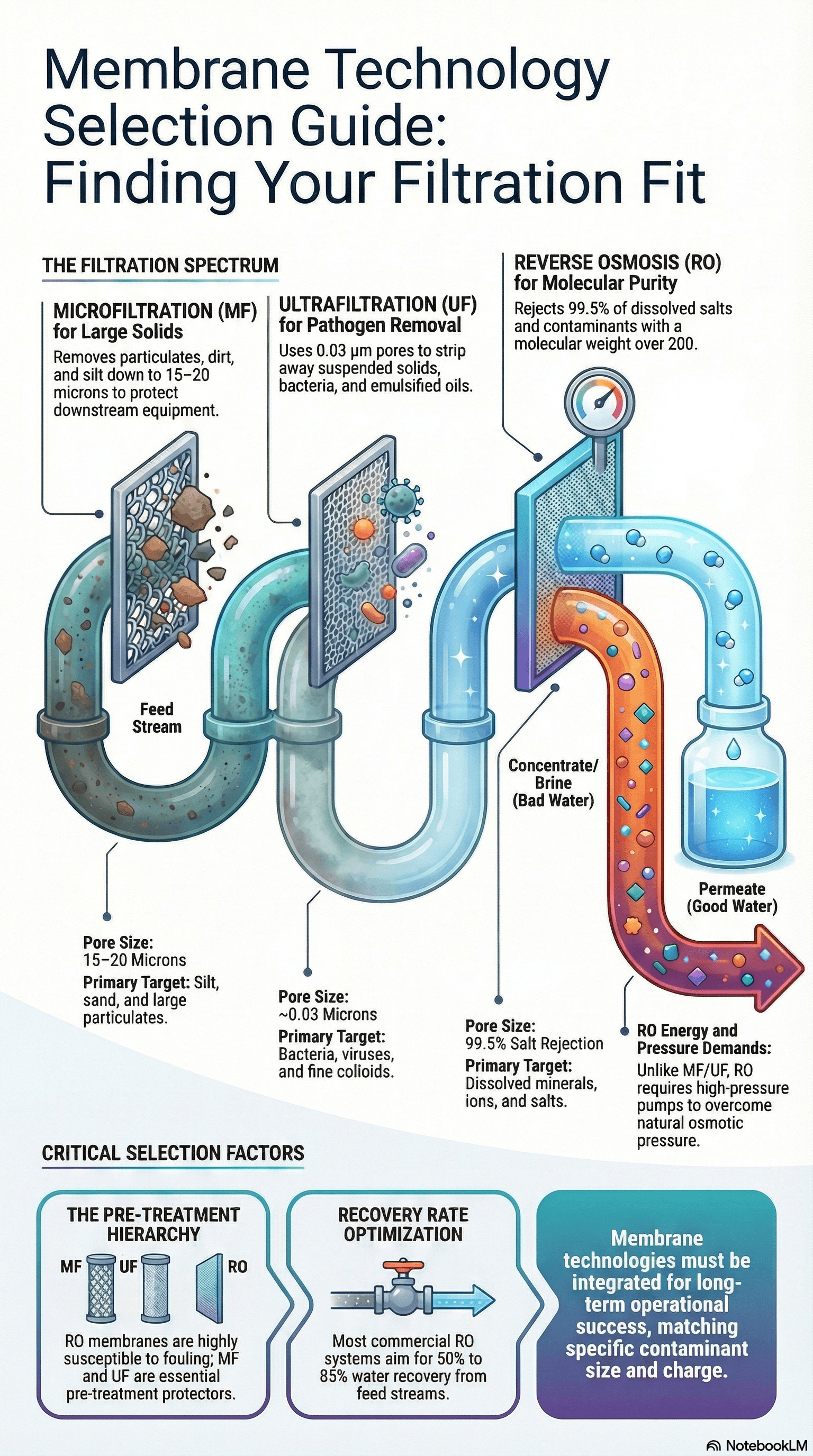
Each membrane type works at a different scale. Reverse osmosis operates at high pressure, 15–80 bar, rejecting dissolved salts, organics and 99% or more of bacteria, with recovery of 65–85%. It is used for desalination, DM water production and ZLD brine concentration. Ultrafiltration runs at low pressure, 1–4 bar, with pore sizes of 0.01–0.1 micron, removing bacteria, viruses and colloids at 90–95% recovery; it protects RO membranes as pre-treatment and forms the core of MBR sewage plants. Nanofiltration softens water and removes divalent ions and colour, while microfiltration pre-filters turbid feeds, both suited to food and beverage, textile and pharmaceutical duties where full desalination is not required. RO membranes are polyamide thin-film composite, and UF and MF membranes are PVDF, with automated clean-in-place tolerating pH 2–12. Membranes are deployed selectively, often in combination, to hit the exact quality the process needs.

How pure can RO and EDI make water for pharmaceutical use?

Double-pass RO followed by Electrodeionisation (EDI) brings conductivity below 0.1 µS/cm, well inside the 1.3 µS/cm USP limit for purified water in pharmaceutical manufacturing. A 50 KLD pharmaceutical system Navbharat Water built in Hyderabad delivers 0.06 µS/cm with TOC consistently below 100 ppb, validated to USFDA requirements.

Municipal or groundwater supply typically carries 500–3,000 mg/L TDS, far above what pharmaceutical purified water, water for injection or data centre cooling can tolerate. Single-pass RO produces permeate at 10–500 µS/cm depending on feed quality; the second RO pass and EDI polishing stage close the gap. Pharmaceutical systems must also be proven, not just built. Navbharat Water provides full Design, Installation, Operational and Performance Qualification (DQ/IQ/OQ/PQ) documentation packages and designs against USP <1231> Water for Pharmaceutical Purposes and USFDA 21 CFR Part 211 good manufacturing practice. The Hyderabad system was validated to USFDA 21 CFR Part 11 requirements and has run for three years with zero out-of-specification incidents. Data centre membrane systems follow ASHRAE Guideline 12 and BSRIA BG 50, and food-grade process water is designed against FSSAI Regulations, 2011.

How long do RO membranes last and how much water do they reject?

With proper pre-treatment and automated clean-in-place, RO membranes typically last 3–5 years. Standard single-pass RO recovers 65–80% of the feed, so 20–35% becomes reject concentrate; for water-stressed sites, a second pass or reject-treatment stage can push overall recovery above 90%.

Membrane life is decided upstream. Navbharat Water systems include SDI monitoring, antiscalant dosing and automated clean-in-place, and ultrafiltration pre-treatment at a flux of 20–80 LMH protects RO membranes from particulate fouling. A membrane replacement programme is available within AMC packages. Reject volume is the other operating cost to plan for. For water-stressed sites, Navbharat Water adds a second pass or an RO-reject treatment stage, such as additional concentration or the HERO process, to recover more water from the concentrate. Feed salinity drives the equipment choice: Navbharat Water has commissioned RO systems on brackish groundwater of up to 12,000 mg/L TDS and seawater of up to 40,000 mg/L TDS, using high-pressure pumps and 8-inch seawater RO elements. RO also differs from a DM plant, which removes ions chemically with resins; the two are often paired, with DM polishing RO permeate where higher purity is needed.
How It Works

How do RO, UF, NF and MF membranes differ?

Navbharat Water deploys RO, UF, NF, and MF membranes selectively — often in combination — to achieve the exact water quality your process requires. No over-engineering. No under-specification.

RO/

Reverse Osmosis

High-pressure (15–80 bar) rejection of dissolved salts, organics, and 99%+ of bacteria. Used for desalination, DM water production, and ZLD brine concentration. Recovery: 65–85%. TDS rejection: >98%.

UF/

Ultrafiltration

Operates at low pressure (1–4 bar). Rejects bacteria, viruses, colloidal particles, and macromolecules. Pore size 0.01–0.1 micron. Used as RO pre-treatment and for MBR STP systems. Recovery: 90–95%.

NF / MF/

Nanofiltration & Microfiltration

NF softens water and removes divalent ions and colour. MF pre-filters turbid feeds. Used in food & beverage, textiles, and pharmaceutical applications where full desalination is not required.

Interactive Guide

Membrane Technology Selection Guide

Separation Spectrum — Coarse → FineMFUFNFRO10 µm0.1 µm0.01 µm0.001 µm<0.001 µmSand / SiltBacteriaVirusesProteinsDivalent ionsMonovalent saltsWaterOperating Pressure:0.1–2 bar1–4 bar3–15 bar8–80 bar

Click any membrane zone on the spectrum to see details.

infographic membrane guide

Treatment Chain

How the treatment works

Membranes are combined selectively; a typical high-purity train runs from coarse to fine.

  1. Step 01

    Microfiltration

    MF pre-filters turbid feeds ahead of the finer membranes.

  2. Step 02

    Ultrafiltration

    Low-pressure UF removes bacteria, viruses and colloids, protecting RO from particulate fouling.

    0.01–0.1 micron

  3. Step 03

    Antiscalant & SDI control

    Antiscalant dosing and SDI monitoring keep RO membranes free of scale.

  4. Step 04

    Reverse osmosis

    High-pressure RO rejects dissolved salts, organics and bacteria.

    TDS rejection >98%

  5. Step 05

    EDI polishing

    Electrodeionisation polishes RO permeate for pharmaceutical purified water.

    <0.1 µS/cm

  6. Step 06

    Reject recovery

    A second pass or RO-reject treatment stage such as HERO recovers more water from the concentrate.

    >90% recovery

Technical Specifications

What are the technical specifications for Membrane Systems?

ParameterValue / Range
RO capacity range1 KLD – 5 MLD
RO TDS rejection> 98%
RO permeate conductivity10 – 500µS/cm
EDI polished water conductivity< 0.1µS/cm
UF flux rate20 – 80LMH
Operating pressure (RO)8 – 80bar
Membrane materialPA TFC (RO), PVDF (UF/MF)
Clean-In-Place (CIP)Automated, pH 2–12 tolerance

RO systems achieve >98% TDS rejection with permeate conductivity of 10–500 µS/cm depending on feed quality. Adding an EDI (Electrodeionisation) polishing stage brings conductivity below 0.1 µS/cm — the specification for USP purified water (PW) in pharmaceutical manufacturing. UF pre-treatment at 20–80 LMH flux rate protects RO membranes from particulate fouling, extending membrane life to 3–5 years.

Case Study

What results has Membrane Systems delivered on a live site?

Pharmaceutical PW System — 50 KLD, Hyderabad, Telangana
Healthcare & Pharma50 KLD

Pharmaceutical PW System — 50 KLD, Hyderabad, Telangana

Double-pass RO + EDI system delivering USP purified water at 0.06 µS/cm conductivity. System validated to USFDA 21 CFR Part 11 requirements. Three years of operation with zero OOS (out-of-specification) incidents. TOC consistently <100 ppb.

View all projects

Compliance Context

Which USP, USFDA, and FSSAI standards apply to your industrial membrane system?

Each application has distinct water quality standards. Navbharat Water's membrane systems are designed and validated against the applicable standard for your industry. Pharmaceutical PW systems undergo full DQ/IQ/OQ/PQ qualification with documentation packages. Data centre systems meet ASHRAE Guideline 12 and BSRIA BG 50 water treatment specifications.

USP 40 <1231> — Water for Pharmaceutical Purposes (Purified Water, WFI)

USFDA 21 CFR Part 211 — Current Good Manufacturing Practice

ASHRAE Guideline 12-2000 — Cooling Tower Water Treatment

FSSAI Regulations, 2011 — Process water quality for food manufacturing

BIS IS 10500 — Drinking water specification (for potable water systems)

What could you save?

Calculate your NPV, IRR & payback period

ROI Calculator

Frequently Asked

Frequently asked questions about Membrane Systems

Request a Technical Audit for Membrane Systems.

Tell us your capacity, inlet profile, and compliance targets. We'll size a system that fits.

Start Your Audit