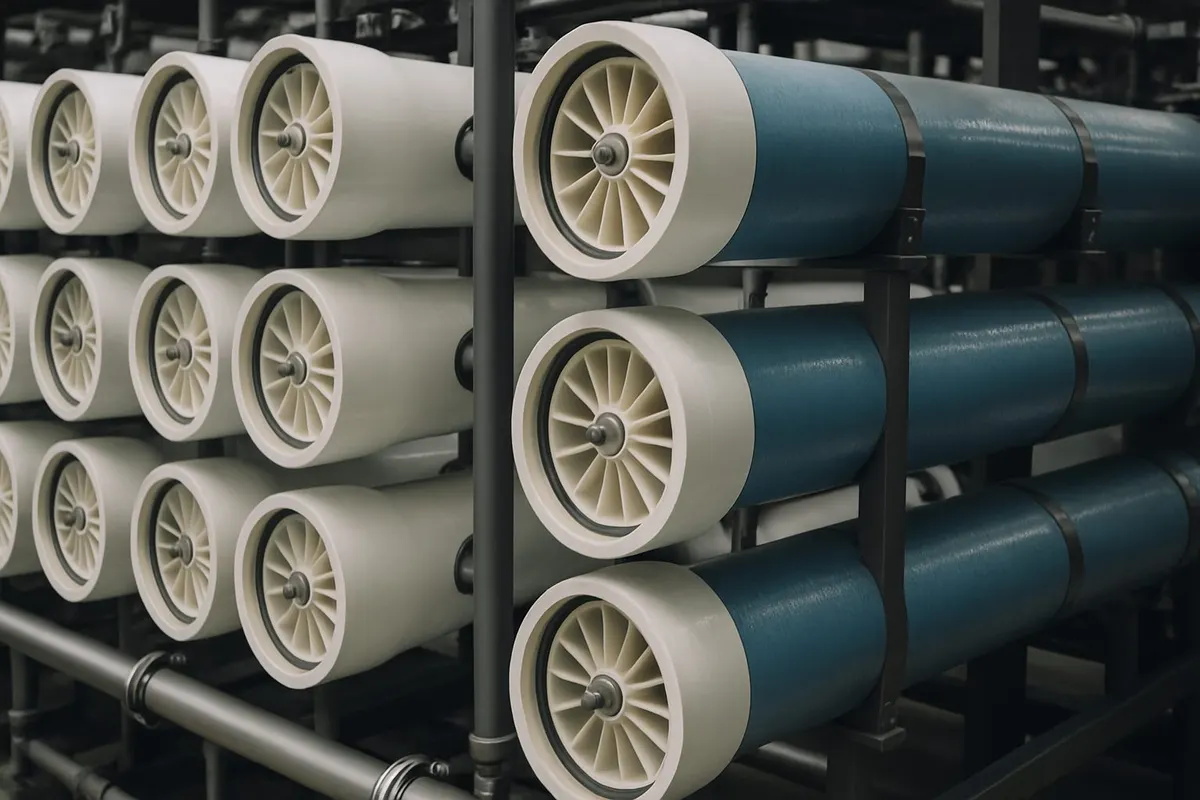
Selecting an industrial RO membrane starts with the feed water, not the catalogue. Match the element family to feed salinity (tap, brackish or seawater), then choose between high-rejection, high-flow and fouling-resistant variants based on the quality target and fouling risk. Good elements typically reject 99.0–99.85% of salt and last 3–5 years with proper pre-treatment.
Which parameters decide RO membrane selection?
Six parameters decide the choice: salt rejection, permeate flow, maximum operating pressure, temperature limit, pH range and chlorine tolerance. For example, Navbharat Water's brackish water elements reject 99.5–99.8% of salt at up to 600 psi (about 41 bar), while seawater elements are rated for 1,200 psi (about 83 bar).
- Salt rejection (%): sets permeate quality. Higher rejection means lower permeate TDS for the same feed.
- Permeate flow and flux: flow per element determines how many elements and pressure vessels are needed. Flux, in litres per m² per hour (LMH), must be set conservatively for dirtier feeds.
- Operating pressure: higher feed TDS means higher osmotic pressure and a higher-rated element and pump.
- Temperature: permeate flow rises with temperature, roughly 3% per °C, while salt passage also increases. Polyamide elements are typically limited to 45 °C.
- pH range: Navbharat Water's RO elements operate at pH 3–10; cleaning chemicals may go wider for short periods.
- Chlorine tolerance: polyamide thin-film composite membranes are damaged by free chlorine, so chlorinated feeds must be dechlorinated first.
What feed water data do you need before selecting a membrane?
You need a full ionic analysis, not just TDS. Hardness, alkalinity, silica, iron, manganese, barium and sulphate govern scaling limits; SDI, turbidity and organics govern fouling. Municipal or groundwater supply commonly carries 500–3,000 mg/L TDS, and seasonal swings can change the design, so sample across seasons where possible.
- TDS and full cation and anion balance
- Silica, barium, strontium and sulphate, which limit recovery through scaling
- Iron and manganese, which foul membranes if oxidised
- Silt Density Index (SDI) and turbidity
- TOC, COD or BOD, especially for treated effluent feeds
- Free chlorine, pH and temperature range
Treated effluent needs particular care. RO feed from an ETP carries organics and biological activity that clean well water does not, so flux is set lower and fouling-resistant elements are often chosen. In ZLD plants, the ETP must typically deliver TSS below 50 mg/L and COD below 500 mg/L before RO.
Which membrane type fits your feed water?
Feed salinity decides the family. Tap water elements suit low-TDS municipal supply, brackish water elements suit groundwater and treated effluent, and seawater elements handle up to about 40,000 mg/L TDS. Navbharat Water has commissioned RO on brackish groundwater of up to 12,000 mg/L TDS. NF and UF serve different roles.
| Type | Typical feed | Salt rejection | Max pressure | Main applications |
|---|---|---|---|---|
| TW (tap water) RO | Municipal and low-TDS supply | 99.0–99.5% | 600 psi | Drinking water, boiler recharge, process water |
| BW (brackish water) RO | Groundwater, treated effluent | 99.5–99.8% | 600 psi | Industrial and commercial RO, boiler feed, wastewater reuse |
| SW (seawater) RO | Seawater and high-TDS feeds | 99.7–99.85% | 1,200 psi | Desalination, high-TDS effluent, leachate |
| NF (nanofiltration) | Hard or coloured water | Divalent ions and colour; partial monovalent | Low | Softening, colour removal, food and textile duties |
| UF (ultrafiltration) | Surface water, secondary effluent | Not a desalting membrane | 1–4 bar | RO pre-treatment, MBR sewage treatment |
Rejection figures in the table are for Navbharat Water's TW, BW and SW 4040 and 8040 elements, all polyamide composite and spiral wound. Rejection is measured at standard test conditions; real plants see somewhat lower figures depending on feed chemistry, recovery and temperature.
High-rejection, high-flow or fouling-resistant: how do you choose?
Choose high-rejection where permeate quality is critical, high-flow where energy and element count matter, and fouling-resistant where the feed is treated effluent or surface water. The trade-off shows in rated figures: in Navbharat Water's BW-4040 range, the HF (high-flow) model rejects 99.5% and the HR (high-rejection) model 99.7%.
- High-rejection (HR): for boiler feed, pharmaceutical pre-treatment and any duty feeding EDI or ion exchange, where every point of salt passage matters.
- High-flow (HF): produces more permeate per element at a given pressure, lowering pump energy or element count, at a modest cost in rejection.
- Fouling-resistant: elements with modified surface chemistry that resists organic and biological fouling, suited to wastewater reuse and ZLD RO stages.
Where high purity is the goal, the answer is often a second pass rather than a better single element. Double-pass RO followed by electrodeionisation (EDI) brings conductivity below 0.1 µS/cm, well inside the USP purified water limits of 1.3 µS/cm conductivity and 500 ppb TOC.
4040 or 8040: which element size should you use?
The numbers describe size: a 4040 element is 4 inches in diameter and 40 inches long, and an 8040 is 8 by 40 inches. An 8040 holds roughly four to five times the membrane area, so larger plants use 8040s to cut vessel count, while 4040s suit smaller skids and pilot units.
As an indication of scale, Navbharat Water's SW-4040 elements produce 1,600–1,900 GPD and SW-8040 elements 6,000–11,000 GPD at the 800 psi test condition. Standardising on one element size across a site also simplifies spares.
What pre-treatment protects RO membranes?
Pre-treatment decides membrane life more than membrane choice does. Most manufacturers require an SDI below 5 and prefer below 3, which on surface water or effluent usually means ultrafiltration. Navbharat Water's UF modules use 0.025 µm PVDF membranes with 6-log bacteria removal, followed by cartridge filtration, antiscalant and dechlorination.
- Clarification or multimedia filtration for high-turbidity feeds
- Ultrafiltration at 20–80 LMH flux where SDI or biological fouling is a risk
- Cartridge filters as the last guard before the high-pressure pump
- Antiscalant dosing to control carbonate, sulphate and silica scaling at the design recovery
- Sodium metabisulphite (SMBS) or activated carbon to remove free chlorine
How long do RO membranes last, and when should they be cleaned?
With proper pre-treatment and automated clean-in-place (CIP), RO membranes typically last 3–5 years. A common trigger for cleaning is a 10–15% fall in normalised permeate flow or a similar rise in differential pressure. Replacement is due when cleaning no longer restores flow or rejection.
Normalising data for temperature and pressure is essential; raw flow readings fall every winter even when the membranes are healthy. Navbharat Water's systems include SDI monitoring, antiscalant dosing and automated CIP with pH 2–12 tolerance, and a membrane replacement programme is available within AMC packages.
Recovery is the other lever. Single-pass RO recovers 65–80% of the feed; for water-stressed sites, a second pass or reject treatment can push overall recovery above 90%, provided scaling is controlled. For system design, element supply and replacement programmes, see Navbharat Water's Membrane Systems at /solutions/membrane-systems.
Frequently asked questions
What salt rejection should an industrial RO membrane have?
Most industrial duties use elements rejecting 99.5% or more. Navbharat Water's brackish water elements reject 99.5–99.8%, tap water elements 99.0–99.5% and seawater elements 99.7–99.85%. Where the permeate feeds EDI, ion exchange or a pharmaceutical system, choose a high-rejection element or a second RO pass rather than relying on a single stage.
Can brackish water membranes treat seawater?
No. Seawater at around 35,000–40,000 mg/L TDS needs operating pressures far above the 600 psi rating of brackish and tap water elements. Seawater elements such as Navbharat Water's SW-4040 and SW-8040 are rated to 1,200 psi and built for high-TDS feeds, paired with high-pressure pumps and energy recovery where justified.
Why does chlorine damage RO membranes?
Most industrial RO elements use a polyamide thin-film composite layer, which free chlorine oxidises, permanently reducing salt rejection. Chlorinated municipal water or disinfected effluent must be dechlorinated before RO, typically with sodium metabisulphite dosing or activated carbon, and an ORP or chlorine analyser is often used to confirm protection.
How often should RO membranes be replaced?
With proper pre-treatment and automated clean-in-place, typically every 3–5 years. Life is shorter where SDI is high, antiscalant dosing fails or chlorine reaches the membranes. Replace elements when cleaning no longer restores normalised permeate flow or salt rejection to acceptable levels.
Is ultrafiltration necessary before RO?
Not always. Clean well water with low SDI may need only cartridge filtration, antiscalant and dechlorination. Surface water, seawater and treated effluent usually benefit from UF, which removes colloids and bacteria that multimedia filters let through, holding SDI low and extending RO membrane life and cleaning intervals.
Ready to discuss your ZLD requirement?
Navbharat Water engineers have commissioned ZLD plants from 10 KLD to 10 MLD across India. Tell us your inlet profile and compliance target.
Request a Technical Audit