Key Questions
What does an industrial water treatment plant do?
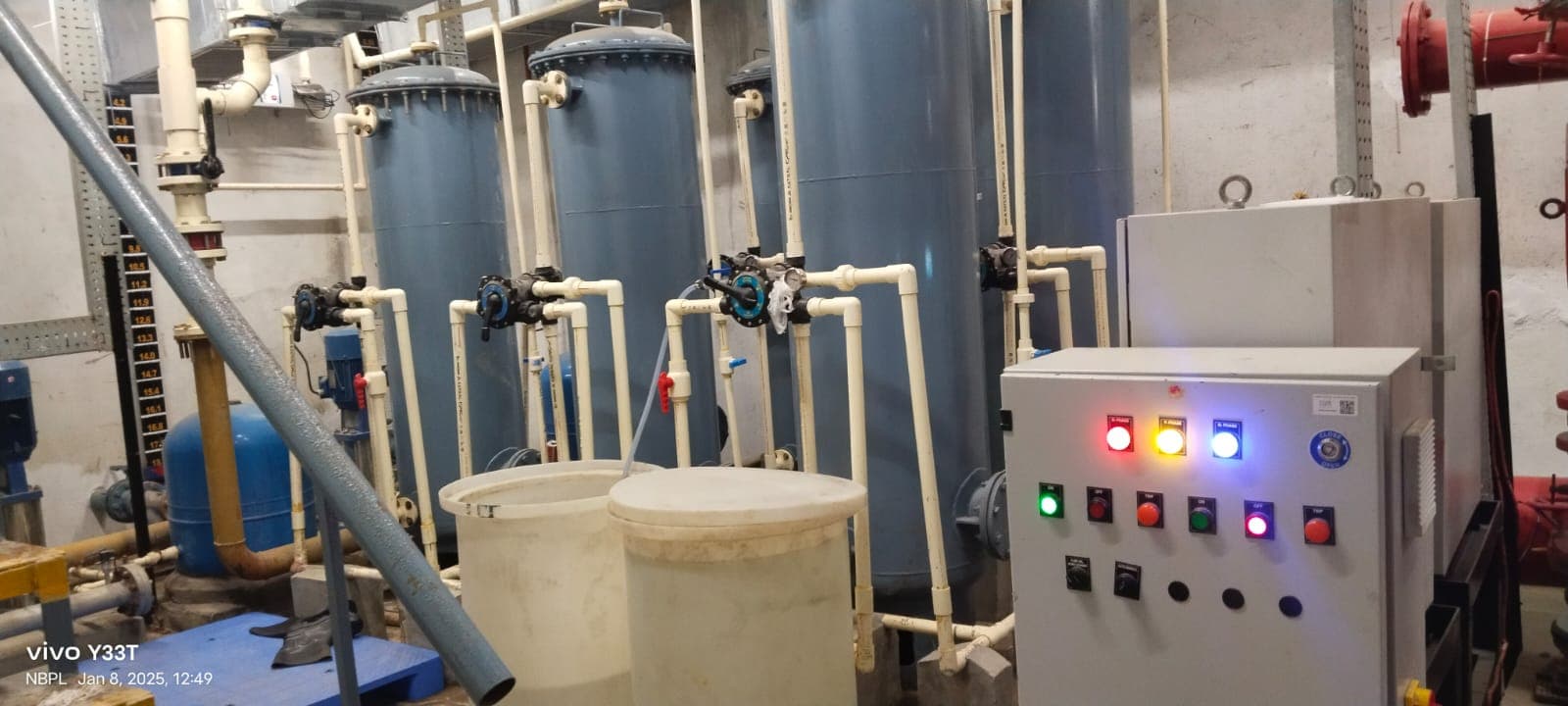
An industrial water treatment plant (WTP) converts raw river, borewell or municipal water into the exact quality a process, boiler or cooling system needs. Navbharat Water WTPs range from 10 KLD to 10 MLD and reduce surface water turbidity of up to 500 NTU to below 1 NTU.
Indian groundwater often carries fluoride, arsenic, iron and hardness at levels that damage boilers, corrode pipes and contaminate products, while surface water brings turbidity, bacteria and seasonal variation. A WTP deals with each in sequence. Clarification by coagulation, flocculation and sedimentation removes turbidity and suspended solids, and tube settlers or lamella clarifiers cut the process footprint by 50% versus conventional designs. Ion exchange softeners then remove more than 95% of hardness, and demineralisation or RO reduces TDS to the level the process or boiler requires, with DM outlet TDS below 10 mg/L. Finally, multimedia filtration, activated carbon and UV or chlorination make the water clear, low in organics and microbiologically safe. Iron removal above 95% addresses the most common borewell problem across Maharashtra, Gujarat and Karnataka, and Navbharat Water has treated groundwater of 3,000+ mg/L TDS for industrial reuse.
What is the difference between a WTP and an RO plant?
A WTP is the complete system that turns raw water into a target quality; RO is one technology used inside it. A full WTP typically includes clarification, filtration, softening or demineralisation and disinfection, with RO added as one of several stages where desalination or polishing is required.
RO membranes are sensitive to turbidity, hardness and chlorine, so the upstream WTP stages exist partly to protect them. Activated carbon filters, for example, adsorb chlorine and chloramines from municipal feed water, preventing chlorine damage to downstream RO membranes, and they also remove colour, taste, odour and trace organics such as THMs. Whether RO is needed at all depends on the end use. Boiler feed purity is driven by operating pressure, and Navbharat Water designs for LP (up to 17 bar), MP (17–40 bar) and HP (above 40 bar) boiler classes, calculating DM plant output and resin or membrane sizing from the boiler operating data rather than a generic estimate. For pharmaceutical and food applications, a final RO or EDI stage delivers USP-grade purity. Every design starts with a detailed source water analysis, so each stage is sized for the specific impurity profile, not a generic catalogue design.
How do I know if my borewell water needs treatment?
Test the water for TDS, hardness, iron, fluoride, arsenic, pH, turbidity and coliform bacteria. Navbharat Water offers a free pre-design water analysis for projects above 50 KLD, with results usually available within 5 working days alongside a preliminary treatment recommendation.
Source quality varies with season, so Navbharat Water sizes every WTP stage for the worst-case seasonal variation in the source water, not the average, and designs against the most stringent standard that applies to the end use. That might be BIS IS 10500:2012 for drinking water, with fluoride brought below 1 mg/L where applicable, FSSAI regulations for food processing water, or IBR requirements for boiler feed. The payoff shows in production. At a 500 KLD food processing WTP in Pune, raw river water at 120 NTU turbidity and 380 mg/L TDS was converted to FSSAI-compliant process water at 0.3 NTU and below 50 mg/L TDS, with boiler feed polished to conductivity below 5 µS/cm. The plant recorded zero product contamination incidents in two years of operation and cleared its FSSAI audit with commendation, showing how a correct source analysis translates into stable process water.