Key Questions
Which hotels has Navbharat Water built STPs for?
Navbharat Water has built sewage treatment plants for ITC Maratha in Mumbai (520 KLD), ITC WelcomHotel in Chennai (100 KLD), Hyatt Regency Chennai (SBR system), Hyatt Regency Kolkata (230 KLD) and Hyatt Regency Bodhgaya (50 KLD STP with a water treatment plant). Each has its own case-study page.
Every one of these plants was built for reuse, not just discharge. At ITC Maratha in Mumbai, the 520 KLD STP delivers treated water for landscape and utility reuse within the property. At ITC WelcomHotel in Chennai, the 100 KLD STP supplies treated water for landscaping and flushing, reducing municipal water dependency. Hyatt Regency Chennai runs STP SBR systems that deliver consistent treated water quality for hotel operations and garden reuse. At Hyatt Regency Kolkata, the 230 KLD STP supplies treated effluent for toilet flushing and cooling tower makeup across the property. At Hyatt Regency Bodhgaya, a 50 KLD STP is combined with a water treatment plant, delivering treated water for hotel operations and landscape reuse in a heritage pilgrimage destination. The projects section below links to each case study, and new hotel plants can be supported after commissioning under an AMC or a full operation and maintenance contract.
What STP capacity does a hotel need?
As a rule of thumb, plan 135 litres per guest room per day for five-star hotels and 100 litres for three- and four-star properties. A 200-room five-star hotel typically needs 30–40 KLD of STP capacity, with banquet peaks of 2–3 times the daily average.
Room count alone understates demand. Banquets and pools push loads higher, and the design must handle banquet peaks that can reach two to three times the daily average. Hotel laundry and kitchens also generate high-strength effluent with grease, detergents and food waste that must be pre-treated before it enters the STP, a design requirement that is often missed. Space is the other constraint. A 500-room property in Mumbai cannot spare 300 m² for a conventional STP, so MBR technology is used to compress the plant to 80–100 m². Navbharat Water MBR STPs deliver outlet BOD below 10 mg/L, a reuse-quality outlet for toilet flushing and irrigation. At a 100 KLD five-star hotel MBR STP in Mumbai, 65 KLD is reused daily, saving ₹22 lakh a year in MCGM water charges, and the property achieved LEED India Silver certification.
Can an STP be installed in a hotel basement without odour or noise?
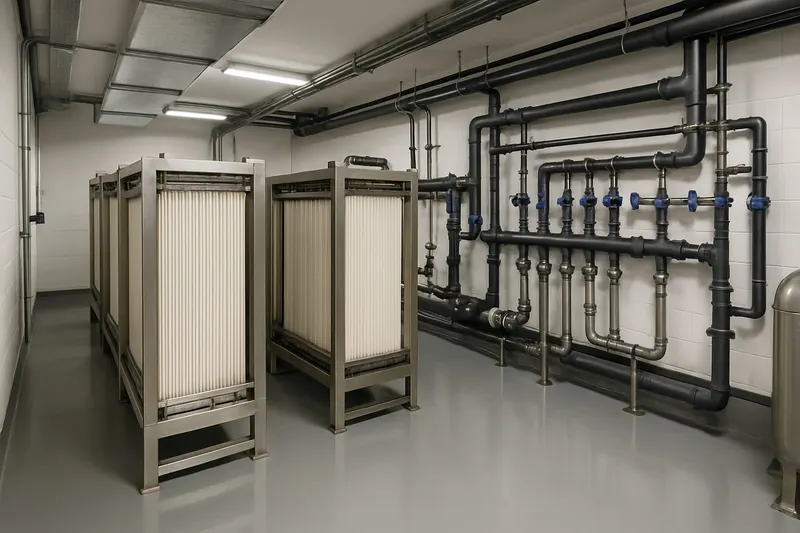
Yes. Navbharat Water MBR STPs are designed for basements: modular tanks fit standard door openings, the plant is fully enclosed to prevent odour, and submerged aeration minimises noise. The plant room needs 3–4 metres of clear height and adequate access for membrane removal.
Odour control is not optional in a hotel basement. Enclosed MBR systems with negative pressure ventilation are required, and Navbharat Water uses sealed GRP or stainless steel tanks with an enclosed odour-control system so sewage smells do not migrate to adjacent spaces. Acoustic enclosures keep noise below 55 dBA. The aim is a plant that guests never know exists and that a facilities team can run without water engineers. Navbharat Water MBR STPs have been used in ITC, Hyatt and Marriott properties, and the Mumbai five-star hotel installation has recorded zero odour complaints in three years. Beyond sewage, hotels need softening and filtration for boiler feed, cooling towers and swimming pools, RO for drinking and kitchen water, and UF for pool water polishing, supplied as compact skids for mechanical rooms and covered under a single Annual Maintenance Contract.
Is an STP mandatory for a hotel Occupancy Certificate?
Yes, in most states, including Maharashtra, Karnataka, Tamil Nadu and Telangana, and RERA also mandates an STP for registered projects. The Occupancy Certificate requires a commissioned and tested STP with outlet test reports; for a 50 KLD Bengaluru business hotel, Navbharat Water secured the BBMP OC on schedule.
Because the Occupancy Certificate depends on the STP, delayed STP commissioning directly delays a hotel opening. The requirement comes from several directions: state building bye-laws such as those of BMC and MCGM in Mumbai, which also require dual plumbing for treated water reuse, Maharashtra RERA for registered projects, and state pollution control board consents. Hotels must also meet FSSAI 2011 drinking water standards in all food and beverage preparation areas and manage Legionella risk in cooling towers and hot water systems under ASHRAE 188. GRIHA and LEED India award water efficiency credits for STP reuse. Navbharat Water provides the commissioning documentation needed for the OC, so the STP is not the final hurdle. The Bengaluru project combined RO and softening for boiler feed and kitchen water with an MBR STP for flushing reuse, and it continues under a full AMC for ongoing operations.