Finding a reliable STP plant manufacturer in Mumbai is critical for real estate developers, industrial facilities, and commercial buildings facing stringent MPCB regulations and water scarcity challenges. This guide covers technology options, cost benchmarks, and how to evaluate Mumbai-based STP providers.
Mumbai's unique constraints — limited space, high land costs, strict MPCB enforcement, and monsoon-related load variations — require specialized STP solutions. A generic STP design that works in Pune or Bangalore will likely fail in Mumbai's conditions.
Mumbai-Specific STP Challenges
Before diving into manufacturers, understand why Mumbai STP projects are different:
1. Space Constraints
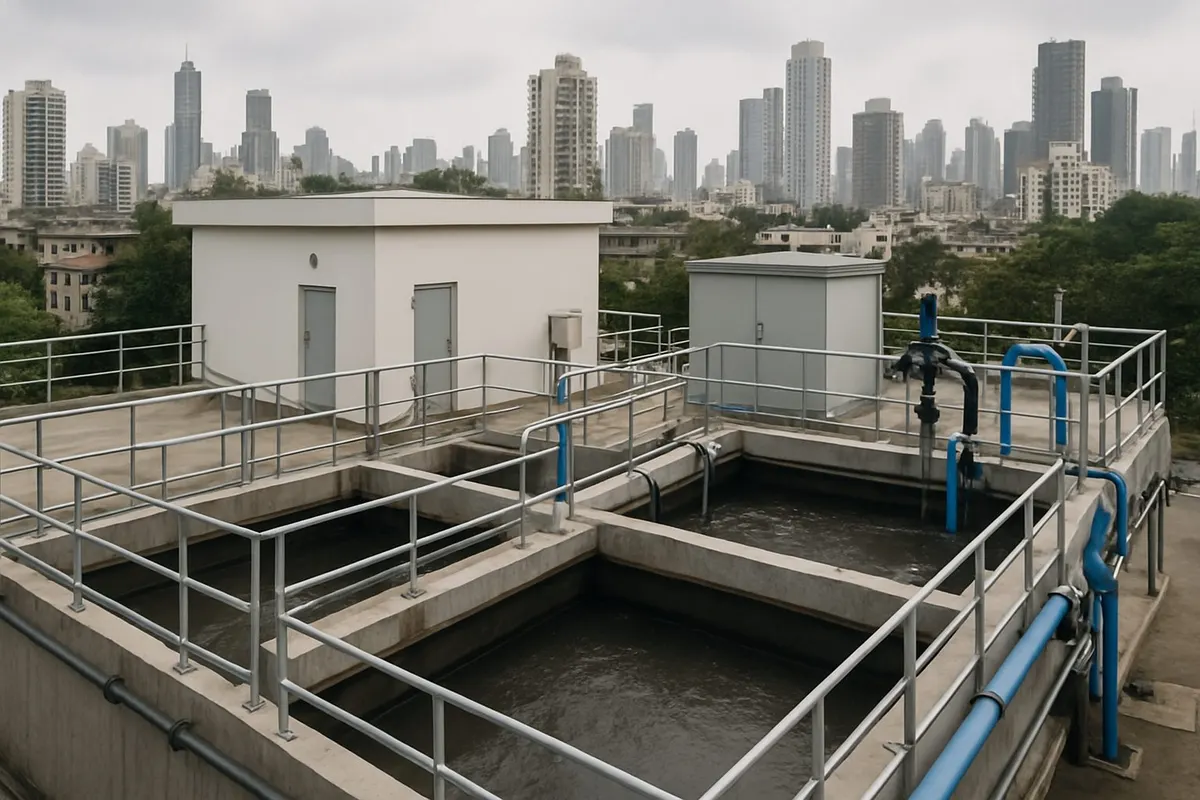
With Mumbai's land costs at ₹30,000-50,000 per square foot in prime areas, STP footprint matters. Underground STPs, basement installations, and rooftop systems are common. This impacts technology choice — MBBR and MBR are preferred over conventional ASP due to smaller footprint.
2. Monsoon Load Variations
Mumbai's 4-month monsoon season sees 3-5x normal hydraulic load. STPs must handle surge flows without compromising treatment efficiency. Equalization tanks and flow distribution systems are mandatory.
3. High-Strength Sewage
Dense commercial areas generate high-BOD sewage (300-500 mg/L) due to restaurants, food courts, and commercial kitchens. Residential complexes with 1000+ units also see higher organic loads than typical housing societies.
4. Reuse Requirements
BMC mandates sewage treatment and reuse for buildings > 2,000 sq.m. Treated water must meet reuse standards for flushing, gardening, and cooling tower make-up. This necessitates tertiary treatment (UF/RO) in most cases.
STP Technology Options for Mumbai
MBBR (Moving Bed Biofilm Reactor)
Best for: Most Mumbai applications
Why it works: Compact footprint (50-60% less than ASP), resilient to load fluctuations, low sludge production, and can be installed underground. MBBR carriers move freely, preventing clogging — crucial during monsoon surges.
Typical specs: BOD removal 85-90%, COD removal 80-85%, TSS < 20 mg/L
SBR (Sequencing Batch Reactor)
Best for: Variable flow patterns, smaller installations
Why it works: Batch process handles flow variations well, automated operation reduces manual intervention, smaller footprint than ASP. Good for buildings with intermittent occupancy patterns.
Typical specs: BOD removal 90-95%, COD removal 85-90%, TSS < 30 mg/L
MBR (Membrane Bioreactor)
Best for: Premium projects with reuse requirements
Why it works: Produces high-quality effluent (TSS < 5 mg/L, BOD < 10 mg/L) suitable for reuse, smallest footprint, eliminates need for separate UF/RO. Higher capital cost but justified for high-end projects.
Typical specs: BOD removal 95-98%, COD removal 90-95%, TSS < 5 mg/L
STP Cost Benchmarks in Mumbai (2026)
| Capacity (KLD) | Technology | CAPEX Range | Annual OPEX | Typical Applications |
|---|---|---|---|---|
| 50-100 KLD | Package MBBR | ₹18-35 Lakhs | ₹4-8 Lakhs | Small residential societies, hotels |
| 100-300 KLD | MBBR + UF | ₹45-120 Lakhs | ₹10-25 Lakhs | Medium residential, commercial buildings |
| 300-500 KLD | SBR + RO | ₹1.8-4.5 Crore | ₹35-65 Lakhs | Large residential complexes, IT parks |
| 500-1000 KLD | MBR + Reuse System | ₹4.5-12 Crore | ₹70-120 Lakhs | Mega townships, commercial complexes |
Note: Underground installations add 20-30% to civil costs but save valuable floor space. Rooftop installations require structural reinforcement costing ₹500-800 per sq.ft.
Top STP Plant Manufacturers in Mumbai
Navbharat Water Pvt. Ltd. — Mumbai HQ
Headquartered in Mumbai with over 40 years of STP project experience across Maharashtra. Navbharat Water designs and installs MBBR, SBR, and MBR systems for residential, commercial, industrial, and municipal clients — with complete MPCB documentation support and long-term O&M contracts.
- Mumbai-based engineering and project management team
- In-house fabrication: no equipment sourcing delays or warranty gaps
- Full MPCB and MahaRERA compliance documentation support
- AMC and O&M contracts with 48-hour emergency response SLA
- Underground, basement, and rooftop STP designs available
WOG Group (Water Origination Group)
Mumbai-based with a focus on packaged STP units for small to mid-size housing societies. Primarily distributes equipment from other manufacturers; limited in-house engineering capability for custom designs above 500 KLD.
ROCHEM Separation Systems
Specialises in membrane-based systems including MBR and RO. Strong technical team; better suited for high-TDS or industrial sewage applications. Less active in the standard residential STP segment.
Buyer's Checklist: Evaluating STP Vendors in Mumbai
Technical Capability
- Experience with underground/basement installations
- Monsoon load handling design
- Reuse system integration (UF/RO)
- Noise and odor control measures
- Automation and remote monitoring
Regulatory Compliance
- MPCB consent management
- MahaRERA documentation for real estate projects
- CPCB standards compliance
- BMC reuse standards adherence
- Environmental clearance support
Project Execution
- In-house engineering team vs. subcontractors
- Local fabrication capability
- Project timeline guarantee
- Warranty and service terms
- AMC and O&M support structure
Frequently Asked Questions
What is the typical STP installation timeline in Mumbai?
Standard STP installation takes 8-12 months from design approval to commissioning. Underground systems may take 10-14 months due to civil work complexity. Monsoon season (June-September) typically delays construction by 1-2 months.
How much space is required for an STP in Mumbai?
A 100 KLD packaged MBBR STP typically needs 40-60 sq mt. A 500 KLD SBR system needs 150-250 sq mt. Underground STPs (common in Mumbai) require 20-30% less above-ground footprint but have higher civil costs.
What are the MPCB discharge standards for treated sewage in Maharashtra?
MPCB standards require: BOD ≤10 mg/L, COD ≤50 mg/L, TSS ≤20 mg/L, pH 6.5–8.5, and Total Coliform <230 MPN/100mL for surface water discharge. For building reuse (flushing, horticulture): BOD ≤10 mg/L, TSS ≤20 mg/L, Total Coliform <200 MPN/100mL.
Looking for an STP Manufacturer in Mumbai?
Navbharat Water's Mumbai team can visit your site, review your MPCB requirements, and provide a detailed STP design and quotation — at no cost.
Conclusion
Selecting the right STP plant manufacturer in Mumbai means more than comparing price per KLD. It means finding a partner who understands the city's space constraints, navigates MPCB and MahaRERA approvals with you, and provides reliable O&M support for years after handover. The short-term savings from a cheaper vendor are quickly erased when approvals stall, treated water fails quality tests, or you're left managing a plant with no local support.
Navbharat Water has designed and commissioned STP plants across Mumbai, Thane, Navi Mumbai, and Pune for residential, commercial, and industrial clients. Contact our Mumbai team for a free site visit and technology recommendation tailored to your project.
Ready to discuss your ZLD requirement?
Navbharat Water engineers have commissioned ZLD plants from 10 KLD to 10 MLD across India. Tell us your inlet profile and compliance target.
Request a Technical Audit