Key Questions
What water quality standard applies to food processing in India?
FSSAI requires water used in food processing to meet BIS IS 10500:2012 potable standards. Key limits are TDS below 500 mg/L, nitrates below 45 mg/L, turbidity below 1 NTU, pH 6.5–8.5 and coliform absent per 100 mL, and Navbharat Water systems log these parameters online for HACCP records.
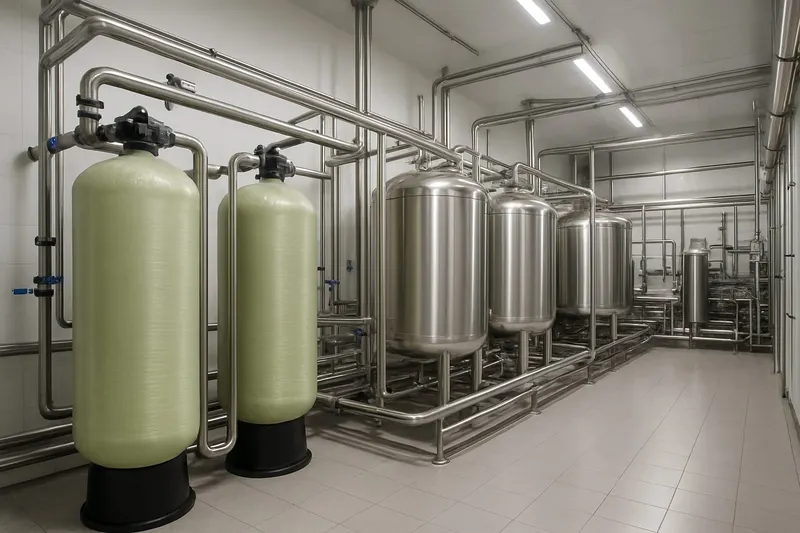
The requirement applies to all water used for washing, mixing, cooking and equipment cleaning, with additional pathogen limits, under Regulation 2.1.1 of the FSSAI 2011 regulations. Food safety systems treat water as a critical control point: ISO 22000:2018 and HACCP both identify water as a potential contamination pathway. Beverage makers go further, needing RO-grade water with conductivity below 50 µS/cm for consistent flavour, because daily TDS variation in municipal supply is not acceptable. High-TDS groundwater, common in the food processing belts of Maharashtra, Rajasthan and Gujarat, adds off-tastes and equipment scaling. Navbharat Water builds FSSAI-compliant process water systems from any source, combining filtration, softening, RO, UV and chlorination, with online pH, TDS, turbidity and chlorine monitoring. At a 500 KLD beverage plant WTP in Pune, river water at 120 NTU became process water at 0.3 NTU and 35 µS/cm, with zero FSSAI audit non-conformances in two years.
How is dairy and food processing wastewater treated?
Food effluent is treated with a grease trap, dissolved air flotation (DAF) to remove fats, and biological treatment such as MBBR or SBR. At a 300 KLD dairy ETP in Nashik, Navbharat Water reduces inlet BOD of 4,200 mg/L to consistently below 25 mg/L.
Food processing effluent is far stronger than typical industrial wastewater, with BOD of 5,000–15,000 mg/L from organic waste, so it needs high-rate biological systems. Dairy effluent typically runs at 1,000–5,000 mg/L BOD with high fat and oil content. Oil and grease from dairy, edible oil and meat processing form surface films that choke biological treatment, which is why DAF is essential before the biological stage. The full train is grease trap, DAF, MBBR or SBR biology for BOD and COD, secondary clarifier and polishing filter, delivering an outlet of BOD below 30 mg/L and COD below 250 mg/L to CPCB norms, with oil and grease at 10 mg/L or less. In the Nashik dairy plant, DAF cut oil and grease from 850 to below 8 mg/L, and MPCB consent has been maintained without conditions. Treated water can be reused for landscaping and cooling.
What documentation do food manufacturers need for FSSAI water audits?
Navbharat Water supplies quarterly NABL-accredited lab test reports, online monitoring records for pH, turbidity, TDS and chlorine, equipment calibration certificates, chemical dosing records and Standard Operating Procedures, all formatted for FSSAI inspection requirements and backed by HACCP-compatible data logging from the online monitoring system.
Lab reports show that water met IS 10500 on the day it was sampled; continuous monitoring shows it met the standard in between. The Smart Water platform logs process water parameters online, issues automated alerts when an FSSAI parameter drifts, and generates monthly compliance reports automatically, so QA teams are not rebuilding records before an inspection. Calibration certificates and dosing records show that the instruments and chemicals behind those numbers were controlled, and SOPs document how operators run the system day to day. This documentation set supports ISO 22000:2018 food safety management and HACCP plans, in which water is treated as a critical control point and a potential contamination pathway. It has held up in practice: the Pune beverage plant WTP recorded zero FSSAI audit non-conformances in two years of operation, alongside a 40% fall in the product complaint rate.