
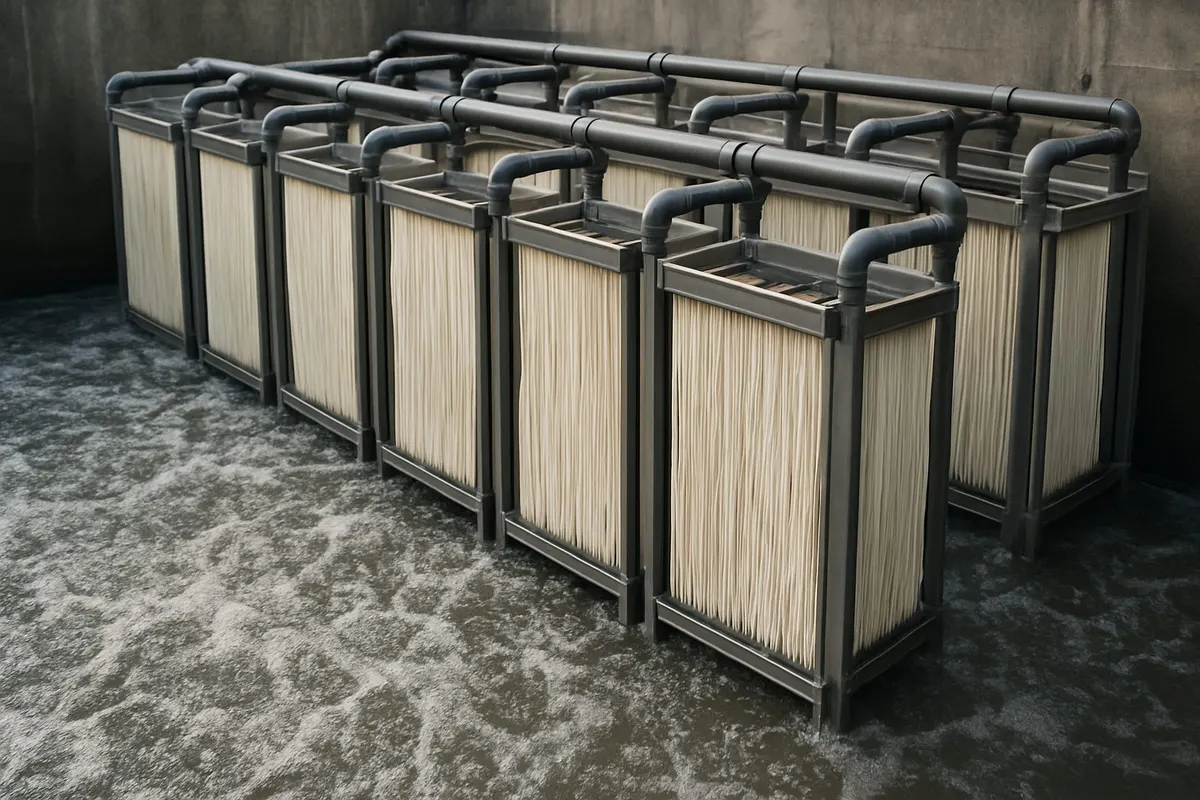
For hotels and IT parks that want to reuse treated water in a tight plant room, MBR is usually the better STP: it needs 30–40% less space than an equivalent SBR and delivers outlet BOD below 10 mg/L. SBR remains a sound, economical choice for townships and campuses where space is available and reuse demands are modest.
How does an MBR sewage treatment plant work?
A Membrane Bioreactor (MBR) combines activated sludge treatment with submerged ultrafiltration membranes in one tank. Hollow-fibre membranes with a 0.04 micron pore size draw treated water out of the aeration tank, so solids are separated by filtration instead of settling and no secondary clarifier is needed.
A typical MBR flowsheet has three steps. Fine screens and an equalisation tank buffer the morning and evening peaks, with enclosed odour control at the inlet. The membrane bioreactor then treats and filters the sewage. Finally, a chlorination contact tank disinfects the permeate before it goes to reuse in flushing, cooling tower makeup, vehicle washing or landscaping.
Because the membrane is a physical barrier, outlet quality does not depend on how well the sludge settles on a given day. That is the main reason MBR performs consistently under the load swings typical of hotels and office buildings.
How does an SBR sewage treatment plant work?
A Sequencing Batch Reactor (SBR) runs biological treatment in timed batches within the same tank: fill, aerate, settle and decant. Each cycle typically takes a few hours, and because settling happens in the reactor itself, SBR also needs no separate clarifier. It is proven, economical and good at nitrogen and phosphorus removal.
Because each tank either receives sewage or settles it, SBR plants use two or more reactors, or an equalisation tank, to accept continuous inflow. A PLC controls the cycle timing, and a decanter draws off the clarified layer at the end of each settle phase.
Decanted SBR effluent generally needs tertiary polishing, commonly pressure sand and activated carbon filtration followed by disinfection, before it is suitable for flushing or cooling tower reuse.
Which technology produces better treated water?
MBR produces clearly better water. Navbharat Water's MBR STPs deliver outlet BOD of 10 mg/L or less, TSS of 10 mg/L or less and faecal coliform below 100 MPN/100 mL. SBR typically delivers BOD around 30 mg/L, which meets the CPCB outlet standard but usually needs polishing before reuse.
| Parameter | MBR | SBR |
|---|---|---|
| Solids separation | 0.04 micron UF membrane | Settling and decanting in the reactor |
| Outlet BOD | 10 mg/L or less | Typically around 30 mg/L |
| Outlet TSS | 10 mg/L or less | Depends on settling; polishing usually needed for reuse |
| Plant room for 100 KLD | About 60–80 m² | About 120–150 m² |
| Reuse without extra polishing | Yes, after disinfection | Usually not |
| Nutrient (N/P) removal | Good, with anoxic zones | Good, through cycle control |
| Capital cost | Higher | Lower |
| Operating attention | Membrane backwash, integrity tests, chemical cleans | Cycle tuning, decanter and filter upkeep |
| Best fit | Hotels, IT parks, basements, high reuse | Townships, campuses, budget-led mid-to-large plants |
The difference matters most when treated water is reused inside the building. Water sent to toilet cisterns and cooling towers must be clear and low in pathogens every day, and a membrane barrier makes that far easier to guarantee than a settling step.
How much space does each technology need?
A 100 KLD MBR STP needs roughly 60–80 m² of plant room, including tanks, the membrane unit and control panel, against 120–150 m² for an equivalent SBR. The saving comes from replacing gravity settling with membranes, which lets the biological tank run at a much higher solids concentration.
In Mumbai and other dense cities, that difference often decides the question. Basement area given to an STP is area not available for parking or services. Navbharat Water's MBR STPs use GRP or stainless steel tanks with sealed lids, enclosed odour control and acoustic enclosures that hold noise below 55 dBA at 3 metres, so the plant can sit in a basement or semi-underground room next to occupied space.
How do capital and running costs compare?
SBR has the lower capital cost; MBR costs more because of the membranes, permeate pumps and membrane air scouring. MBR can still win on total cost where land is expensive or water is reused: at one 100 KLD hotel MBR in Mumbai, recycling 65 KLD a day saves ₹22 lakh a year in water charges.
Running costs differ in kind as well as amount:
- Energy: MBR uses additional air to scour the membranes, so power consumption per KL is generally higher than for SBR.
- Maintenance: MBR needs monthly membrane backwash and integrity testing and quarterly chemical cleaning. SBR needs attention to cycle timing, decanters and tertiary filters.
- Consumables: MBR membranes are replaced periodically; SBR polishing filters need media replacement.
- Skills: both need trained operators. MBR is less forgiving of skipped cleaning; SBR is less forgiving of poorly tuned cycles.
The fairest comparison adds capital, energy, maintenance, membrane or media replacement and the value of reused water over the life of the building, rather than comparing purchase prices alone.
Which technology suits hotels, IT parks and residential complexes?
Choose MBR where plant room space is scarce, the plant sits below occupied floors, or treated water will be reused for flushing and cooling. Choose SBR for townships and institutional campuses with open land and a budget focus. Navbharat Water builds STPs from 10 KLD to 2 MLD in both technologies.
- Hotels and resorts: MBR, for basement installation, odour control and reuse in flushing and pool or cooling makeup.
- IT parks and commercial offices: MBR where cooling tower makeup is a large water demand; SBR where the campus has space and reuse is limited to landscaping.
- Residential complexes: either, depending on plot size, reuse targets and whether the society will fund an operator with membrane experience.
- Townships and institutional campuses: SBR, or conventional activated sludge where footprint is not constrained.
- Sites with variable loads, such as industrial campuses: MBBR is often the better third option.
Timelines are similar for both. For transit and infrastructure projects, Navbharat Water's containerised MBR STPs of 10–100 KLD can be deployed in 8–12 weeks from order.
What do regulators require before an Occupancy Certificate?
Most Indian states require an on-site STP for buildings above a set built-up area, and Occupancy Certificates are withheld until the STP is commissioned and test reports submitted. The plant must meet the sewage discharge standards notified under the Environment (Protection) Rules, which cap outlet BOD at 30 mg/L (20 mg/L in metro cities and state capitals). The NGT has since directed stricter norms and many State Pollution Control Boards now write tighter limits into consent conditions, so design to your own consent and any reuse requirements.
Beyond outlet limits, approvals typically involve SPCB consent, state building bye-laws, and urban local body requirements for dual plumbing and reuse connections. MBR's margin below the outlet limits gives more headroom when inspectors test on a bad day, and supports water-efficiency credits under GRIHA and LEED India. Navbharat Water supplies commissioning reports, test certificates and SPCB consent application support with each STP.
To compare options for a specific building, see Navbharat Water's MBR STPs at /solutions/sewage-treatment, where the full specifications and a 100 KLD hotel case study are published.
Frequently asked questions
Is MBR always better than SBR?
No. MBR gives better water in less space, but costs more to build and needs disciplined membrane care. SBR is proven, economical and good at nutrient removal, which makes it a sensible choice for townships and campuses with land available and limited reuse. The right answer depends on space, reuse targets, budget and operating capability.
Can SBR treated water be reused for toilet flushing?
Yes, but usually only after tertiary treatment. Decanted SBR effluent typically passes through pressure sand and activated carbon filters and then disinfection before it meets flushing water quality. MBR permeate needs only disinfection, because the 0.04 micron membrane has already removed suspended solids and most bacteria.
Can an MBR STP be installed in a basement?
Yes. Navbharat Water's MBR STPs are designed for basement and semi-underground plant rooms, with GRP or stainless steel tanks, sealed lids and an enclosed odour-control system so smells do not migrate to adjacent spaces. Acoustic enclosures keep noise below 55 dBA at 3 metres.
How often do MBR membranes need cleaning?
Navbharat Water's maintenance schedule for MBR STPs includes monthly membrane backwash and integrity testing and quarterly chemical cleaning, alongside sensor calibration. These tasks, sludge disposal coordination and 24-hour emergency response are covered under an Annual Maintenance Contract for clients who prefer not to run the plant themselves.
Can an existing SBR plant be upgraded to MBR?
Often, yes, because both are activated sludge processes. Submerged membranes can be installed in or alongside the existing reactor, which usually lets the plant treat more sewage in the same tanks and produce reuse-grade water. Feasibility depends on tank geometry, blower capacity and the condition of the existing civil works, so a site survey comes first.
Sources
Ready to discuss your ZLD requirement?
Navbharat Water engineers have commissioned ZLD plants from 10 KLD to 10 MLD across India. Tell us your inlet profile and compliance target.
Request a Technical Audit