Zero liquid discharge (ZLD) means no effluent leaves your site: water is recovered for reuse and the residue leaves as dry salt. For textile, pharmaceutical, tannery, dye and distillery units in India, ZLD is increasingly a consent condition rather than an option, enforced by CPCB, State Pollution Control Boards and the National Green Tribunal.
What does zero liquid discharge actually mean?
ZLD is a treatment outcome, not a single technology. A ZLD plant recovers 95–99% of incoming effluent as reusable water and converts the remaining dissolved solids into dry salt, so the plant boundary has no liquid outlet at all. An ETP treats effluent to discharge standards; ZLD removes the discharge altogether.
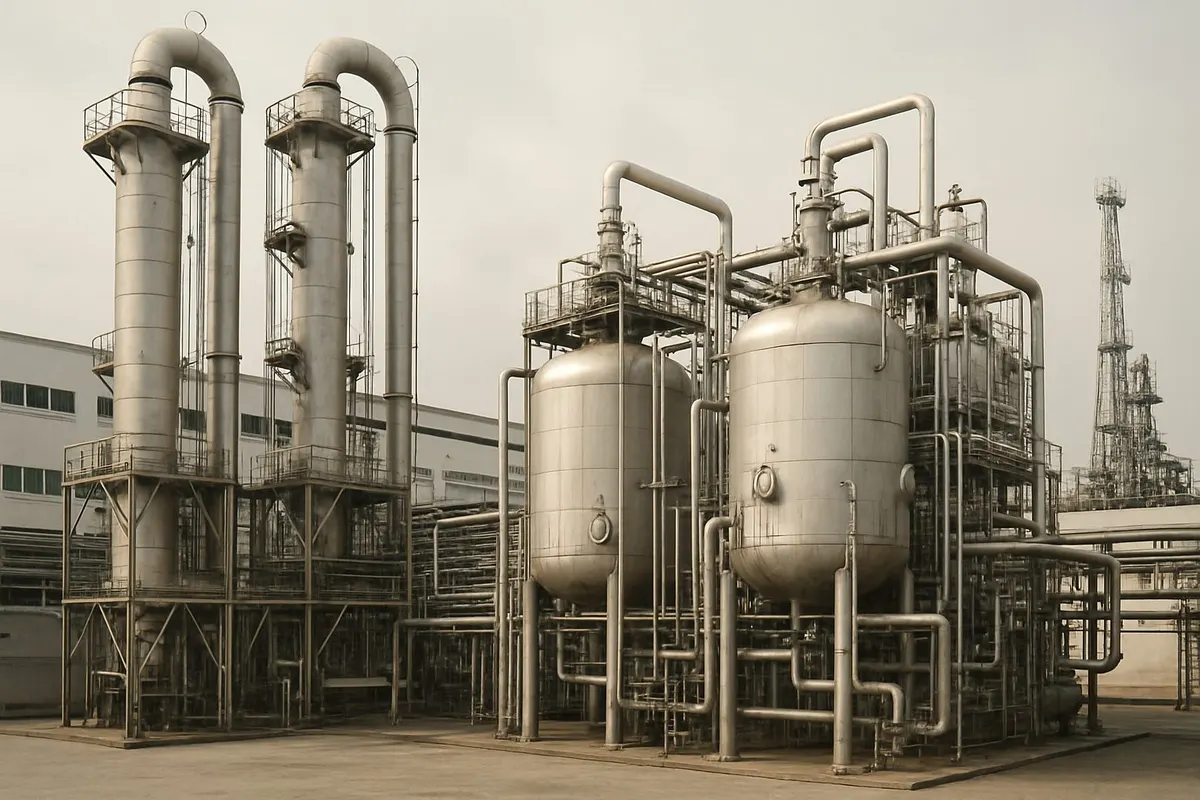
In practice a ZLD train has three stages. Biological and chemical ETP treatment removes BOD, COD and suspended solids. Reverse osmosis then splits the treated effluent into clean permeate, typically 70–80% of the feed, and a concentrated reject. Finally, a Multiple Effect Evaporator (MEE) and an Agitated Thin Film Dryer (ATFD) evaporate the reject until only solids remain; their condensate is recovered too.
The distinction matters at inspection. A unit with a well-run ETP can still be in breach if its consent requires ZLD, because any outfall counts as discharge, including RO reject sent to a drain or stored in open ponds that overflow in the monsoon.
Which industries does the ZLD mandate cover?
ZLD requirements fall mainly on water-intensive, high-TDS sectors. CPCB directions and State Pollution Control Board orders apply to designated industries, and in practice that means textile processing clusters, red-category pharmaceutical units, tanneries, dye manufacturers and distilleries, plus any unit whose individual consent specifies zero discharge.
- Textile dyeing, printing and bleaching units in notified clusters such as Tirupur, Surat, Panipat and Ludhiana
- Pharmaceutical manufacturers classified in the red category
- Tanneries and leather processing units
- Dye and dye-intermediate manufacturers
- Caustic soda, soda ash and chlor-alkali plants
- Sugar mills with attached distilleries
Those directions are only part of the picture. The operative document for any individual unit is its Consent to Operate from the State Pollution Control Board. If the consent says zero discharge, that is the standard the unit is inspected against, whatever its sector.
Who enforces ZLD, and under which laws?
Three bodies share enforcement. CPCB sets national standards and issues directions under the Environment (Protection) Act, 1986. State Pollution Control Boards grant and police consents under the Water Act, 1974 and the Air Act, 1981. The National Green Tribunal, set up in 2010, hears environmental cases and can order closure and environmental compensation.
| Body | Legal basis | Typical actions |
|---|---|---|
| CPCB | Environment (Protection) Act, 1986; Water Act, 1974 | National standards, directions to units and SPCBs, inspections |
| State Pollution Control Board | Water Act, 1974; Air Act, 1981 | Consent to Establish and Consent to Operate, inspections, closure and utility disconnection directions |
| National Green Tribunal | National Green Tribunal Act, 2010 | Hearing complaints and appeals, closure orders, environmental compensation |
Enforcement is also increasingly data-driven. Units in CPCB's highly polluting categories must run Online Continuous Effluent Monitoring Systems (OCEMS) that stream data to the regulators, so flow recorded on an outlet that is not supposed to exist becomes visible without anyone visiting the site.
What happens if a unit does not comply?
The main risk is closure, not a fine. Under Section 5 of the Environment (Protection) Act, 1986 and Section 33A of the Water Act, 1974, regulators can direct a unit to shut down and have its electricity and water supply disconnected. Environmental compensation and penalties follow, and restart depends on demonstrated compliance.
The usual sequence is an inspection or monitoring alert, a show-cause notice, a hearing and then directions. Notices commonly carry deadlines of 30–60 days, and a credible compliance plan with firm dates and a contractor engaged carries far more weight than a request for time.
The penalty provisions of the environmental statutes have been amended in recent years, so check the current text with legal counsel rather than relying on older summaries. The commercial arithmetic does not change: a closure order stops production, and lost output usually outweighs the cost of the treatment plant.
What does a compliant ZLD treatment train include?
A compliant ZLD plant has five stages: primary ETP, biological treatment, RO concentration, multiple effect evaporation and final drying. Each stage must hand over a defined quality to the next; RO feed, for example, typically needs TSS below 50 mg/L and COD below 500 mg/L to avoid rapid membrane fouling.
| Stage | Technology | Key output parameter |
|---|---|---|
| Pre-treatment | Primary ETP | TSS <50 mg/L, COD <500 mg/L (RO feed) |
| Secondary treatment | Biological (MBBR/SBR) | BOD <30 mg/L |
| RO concentration | High-rejection RO | Permeate TDS <100 mg/L; reject TDS 15,000–30,000 mg/L |
| Thermal evaporation | MEE (3-effect) | Condensate TDS <50 mg/L; concentrate 25–30% solids |
| Final drying | ATFD | Dry salt >98% purity |
Three design decisions determine whether a ZLD plant keeps working after commissioning:
- Pre-treatment sized for the real inlet profile, including peak colour and COD loads from batch processes, not a monthly average.
- RO recovery set against scaling limits. Pushing RO too hard to shrink the evaporator saves capital but increases cleaning frequency and membrane replacement.
- Evaporator materials chosen for the chloride level, and a plan for the salt. Mixed salt typically goes to landfill; segregated sodium sulphate or sodium chloride can sometimes be sold.
Energy is the largest running cost. Navbharat Water's ZLD plants draw 8–18 kWh per m³, highest for MEE-based trains and lowest for RO-dominated configurations, which is why maximising RO recovery before the evaporator matters so much.
What does a ZLD plant cost to build and run?
Capital cost for a 500 KLD ZLD plant (ETP + RO + MEE + ATFD) typically ranges from ₹3.5 Cr to ₹5.5 Cr, with operating costs of ₹80–120 per KL treated. Across all sizes, ZLD systems range from about ₹50 lakh for small plants to ₹25 Cr for large plants with energy recovery.
The main cost drivers are:
- Inlet TDS and COD, which set the size of the RO and evaporation stages
- The recovery target and how much reject reaches the evaporator
- Evaporator type and steam source, which dominate operating cost
- Salt characterisation and disposal route
- Civil works, site constraints and the level of automation and monitoring
Recovered water offsets part of the cost. For a 1 MLD ZLD plant, average savings in freshwater costs are ₹2–5 Cr a year. On a 2 MLD textile cluster ZLD in Surat, Navbharat Water achieved 99.2% water recovery, the client cut freshwater costs by ₹1.8 Cr a year, and dry salt was sold to chemical traders at ₹4/kg. Where an ETP already exists, retrofitting RO and evaporation typically costs 30–40% less than a greenfield ZLD plant.
How long does it take to reach ZLD compliance?
A standard 500 KLD ZLD plant takes 5–6 months from order to operational compliance: 4–6 weeks of design, 10–14 weeks of fabrication, 6–8 weeks of civil work running in parallel and 2–3 weeks of commissioning. Consent applications should run alongside the engineering; allow 8–12 weeks for consent processing.
- Effluent characterisation across a representative production cycle, not a single grab sample
- Water and salt mass balance to fix RO recovery and evaporator capacity
- Technology selection, then a consent application or amendment
- Fabrication, civil works and erection
- Commissioning, performance trial and Consent to Operate
If a notice is already on the table, an interim arrangement can buy time. Navbharat Water can mobilise for a site assessment within 48 hours and provide a compliant interim solution while permanent infrastructure is engineered and commissioned.
Navbharat Water designs and builds ZLD plants from 10 KLD to 10 MLD for feed TDS of 2,000–80,000 mg/L, and has commissioned more than 150 treatment plants. To scope a new plant or a retrofit, see Navbharat Water's Zero Liquid Discharge systems at /solutions/zero-liquid-discharge, or the BOOT and Water-as-a-Service options at /solutions/service-models if capital is the constraint.
Frequently asked questions
Is ZLD mandatory for every industry in India?
No. ZLD applies to designated sectors, mainly textile processing, red-category pharmaceuticals, tanneries, dyes, chlor-alkali and distilleries, and to any unit whose Consent to Operate specifies zero discharge. Other units must meet the discharge standards in their consent. Check your current consent document first, because that is the standard your State Pollution Control Board will inspect against.
Can an existing ETP be upgraded to ZLD?
Usually, yes. The existing treatment train is assessed to find where RO concentration can be integrated, and an evaporation stage is added as a bolt-on. A retrofit of this kind typically costs 30–40% less than a greenfield ZLD plant, provided the existing ETP can reliably deliver RO-feed quality.
What happens to the salt from a ZLD plant?
It depends on the effluent chemistry. ATFD salt of 98% or higher purity can be recovered as sodium sulphate, used in detergent manufacturing, or sodium chloride for general industrial use. Mixed salts are typically landfilled. Navbharat Water helps clients connect with offtake partners where the salt quality allows resale.
Is ZLD viable for units below 50 KLD?
Below 50 KLD, capital cost per unit volume is high. Options include shared ZLD infrastructure for small clusters, or a rental model in which Navbharat Water owns the ZLD equipment and charges a treatment fee per kilolitre, removing upfront capital. BOOT contracts, where Navbharat Water finances the whole plant, are viable from 50 KLD upwards.
How long does a ZLD plant take to commission?
A standard 500 KLD plant takes 5–6 months from order to operational compliance, with design, fabrication, parallel civil work and commissioning. Consent processing typically needs 8–12 weeks, so the application should be filed while engineering is under way rather than after the plant is built.
Sources
- CPCB: Draft Indicative Guidelines on Techno-Economic Feasibility of Implementing ZLD for Water Polluting Industries (2014)
- CPCB: Charter for Water Recycling & Pollution Prevention in Textile Industries in Ganga River Basin
- CPCB: Charter for Zero Liquid Discharge (ZLD) in Molasses Based Distilleries
- Environment (Protection) Rules, 1986, Schedule VI: General Standards for Discharge of Environmental Pollutants (CPCB)
- PIB / MoEFCC: Online Monitoring of Pollution (CPCB OCEMS directions, April 2022)
Ready to discuss your ZLD requirement?
Navbharat Water engineers have commissioned ZLD plants from 10 KLD to 10 MLD across India. Tell us your inlet profile and compliance target.
Request a Technical Audit