CPCB's OCEMS requirement obliges highly polluting industries, meaning the 17 CPCB categories plus Grossly Polluting Industries, to monitor effluent continuously and stream the data to the CPCB server. For existing units the original deadlines have passed; for new units, State Boards typically write OCEMS into consent conditions before operation begins.
This guide explains who is covered, which parameters must be measured and to what accuracy, how data reaches the regulator, and how to keep a plant that is permanently visible to CPCB within its limits.
What is OCEMS?
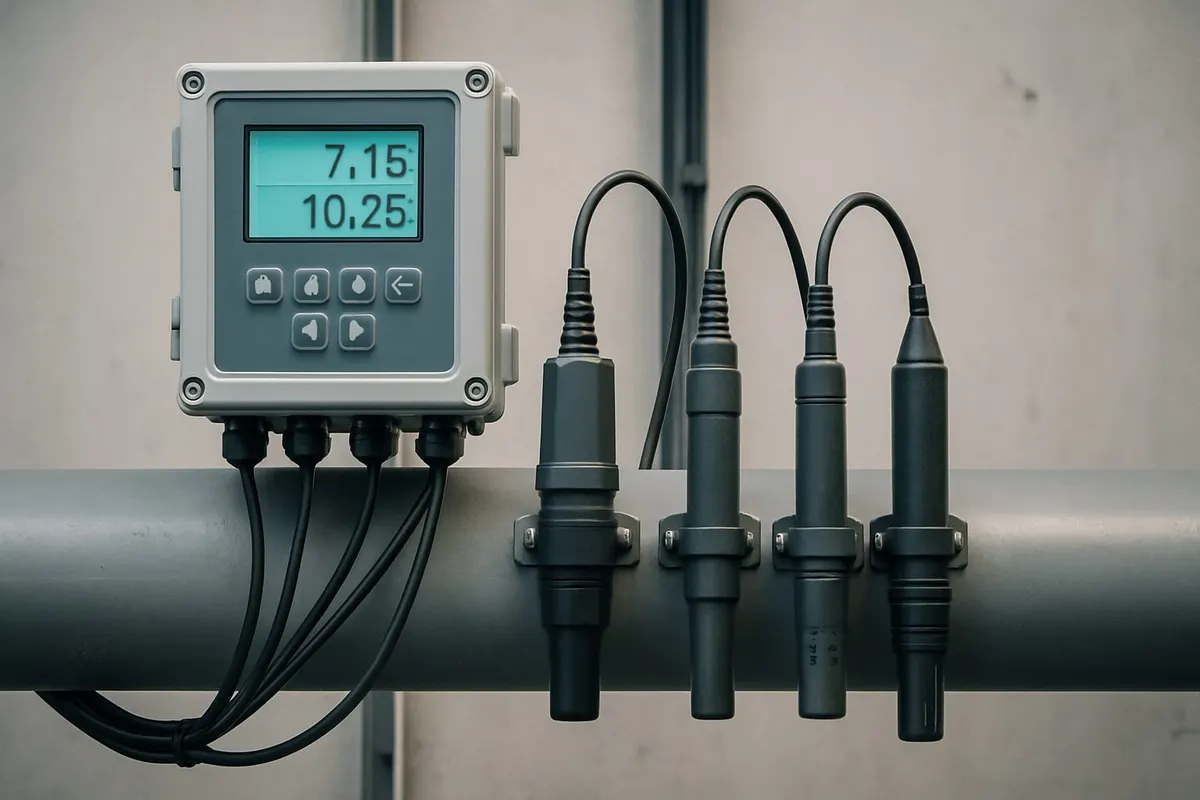
OCEMS, the Online Continuous Effluent Monitoring System, is a set of analysers at the effluent outlet that measure parameters such as pH, COD, BOD, TSS and flow continuously and transmit the data, unaltered, to the regulator. Navbharat Water's installations send readings every 60 seconds to the CPCB CEMS server and a private dashboard simultaneously.
OCEMS replaces the old model of periodic grab samples and monthly laboratory reports, under which an exceedance could run for weeks before anyone noticed. A parallel requirement covers stack emissions from units with air discharges; this guide covers effluent.
| Aspect | Manual sampling | OCEMS |
|---|---|---|
| Frequency | Periodic grab or composite samples | Continuous, transmitted every 60 seconds on Navbharat Water systems |
| When exceedances surface | At the monthly lab report | In real time, to plant and regulator |
| Who sees the data | Plant and auditors, after the fact | CPCB server and plant dashboard simultaneously |
| Data integrity | Depends on log books | Tamper-proof; cannot be altered or deleted |
| Records | Paper or spreadsheets | Digital; retained 10 years on Navbharat Water's platform |
Which industries must install OCEMS?
CPCB's directions cover 17 categories of highly polluting industries, depending on whether a unit discharges effluent, emissions or both. Grossly Polluting Industries discharging into the Ganga basin and its tributaries are also covered, and State Boards can extend online monitoring to other red-category units through consent conditions.
The 17 categories are:
- Aluminium smelters, copper smelters and zinc smelters
- Cement and thermal power plants
- Chlor-alkali (caustic soda) plants
- Distilleries and sugar mills
- Dyes and dye intermediates
- Fertiliser plants
- Integrated iron and steel plants
- Oil refineries and petrochemical complexes
- Pesticide manufacturers
- Pharmaceutical manufacturers
- Pulp and paper mills
- Tanneries and leather processing units
Textile processing is a common example of extension through State Board consent. In Maharashtra, for instance, red-category units in MIDC areas are expected to run an ETP with OCEMS. Your consent order is the definitive statement of what your unit must monitor.
By when must industries comply?
The original compliance deadlines for existing units in the 17 categories passed years ago, so any covered unit without a working, connected OCEMS is already out of compliance. For new or expanding units, the requirement typically appears in the Consent to Establish or Consent to Operate, so it must be working before commissioning.
Enforcement is direct. State Boards and CPCB can see exceedances and data gaps as they occur, and under the Water (Prevention and Control of Pollution) Act, 1974 they can issue directions that include closure of a unit and disconnection of electricity or water supply. A monitor that is offline, or a plant that exceeds limits in full view of the regulator, both carry risk.
Which parameters and sensors are required?
The core effluent set is pH, COD, BOD, TSS and flow, with temperature commonly added; some sectors must also monitor sector-specific parameters under their consent. Accuracy expectations are tight, for example ±0.1 pH units and ±2% of reading for electromagnetic flow meters, so analyser selection matters as much as installation.
| Parameter | Typical sensor type | Accuracy |
|---|---|---|
| pH | Electrochemical probe | ±0.1 pH |
| COD | UV-Vis spectrophotometer | ±10% of reading |
| BOD | Online analyser, typically correlated with COD | ±15% of reading |
| TSS | Turbidimetric | ±10% of reading |
| Flow | Electromagnetic flow meter | ±2% of reading |
Navbharat Water's platform can extend beyond the regulatory set to DO, TDS and ORP at inlet and outlet points. These are not usually reported to CPCB, but they give operators early warning that the treatment process is drifting before the outlet parameters move.
How does OCEMS data reach the CPCB server?
Analysers feed a data acquisition system that timestamps readings and transmits them directly to the CPCB server, with no manual handling. Navbharat Water's edge gateway transmits every 60 seconds, buffers data locally during an internet outage and syncs automatically when connectivity returns, so the regulatory record has no gaps.
- Registration: Navbharat Water's OCEMS installations are registered with the CPCB CEMS server.
- Integrity: data sent to CPCB cannot be altered or deleted, which is the regulatory intent.
- Availability: the platform carries a 99.5% uptime guarantee, with local alarms and operator displays on the gateway.
- Security: the OCEMS and SCADA network is segmented from corporate IT, external access uses encrypted VPN with multi-factor authentication, and data travels over TLS 1.3, following IEC 62443.
How often should OCEMS analysers be calibrated?
Navbharat Water calibrates its CPCB-approved sensors monthly and keeps the records for audit. Calibration protects the plant as much as it satisfies the guidelines: a COD analyser drifting high reports an apparent violation to the regulator in real time, while one drifting low hides a real problem until the next laboratory check.
- Keep a calibration log for every analyser, with the reference standard used.
- Cross-check online readings against periodic laboratory results and investigate persistent differences.
- Clean optical and electrochemical sensors on a fixed schedule; fouling is a frequent source of drift.
- Record and explain any data gap, maintenance window or sensor replacement.
How do you make OCEMS work in your favour?
OCEMS makes every exceedance visible, so the goal is a plant that stays within limits, not just a monitor that reports. Pairing OCEMS with early alerts works: in a 12-plant Surat textile group on Navbharat Water's platform, compliance exceedances fell 94% in the first year.
- Alert before the limit: WhatsApp and SMS alerts reach the EHS manager and Navbharat Water remote support when a parameter approaches its limit, with a response SLA of under 15 minutes remotely and 4 hours on site.
- Predict, do not just react: a digital twin running on the same data forecasts problems such as membrane fouling or aeration failure 24–72 hours ahead.
- Retrofit quickly: a standard five-sensor retrofit covering pH, COD, flow, TSS and temperature typically takes 2–3 days on a 500 KLD plant, with no production shutdown.
- Share the burden: for BOOT clients, Navbharat Water operators start corrective action without waiting for a client call.
Navbharat Water supplies, installs and maintains CPCB-compliant OCEMS as part of Smart Water Monitoring (/solutions/smart-water), currently live on 45+ plants across India. Where the monitor shows the treatment itself is the problem, the Effluent Treatment solution (/solutions/effluent-treatment) covers ETP upgrades.
Frequently asked questions
Can OCEMS data be edited or deleted?
No. CPCB-mandated OCEMS installations transmit data to the CPCB CEMS server in real time, and the unit cannot alter or delete it. That is the regulatory intent. The practical consequence is that transparency only works in your favour if the plant consistently operates within its consent limits, which is why alerting and fast response matter.
Can OCEMS be retrofitted on a running plant?
Yes. Navbharat Water's sensors are designed for retrofit with minimal process disruption. A standard five-sensor OCEMS retrofit covering pH, COD, flow, TSS and temperature typically takes 2–3 days on a 500 KLD plant, with no production shutdown required. Registration with the CPCB server and dashboard set-up follow installation.
What happens if the plant's internet connection fails?
The edge gateway stores data locally and keeps the OCEMS sensors operating independently of the cloud. When connectivity is restored, all stored data syncs automatically to the CPCB server and the plant dashboard, so the record has no gaps. Local alarms and operator displays keep working throughout the outage.
Is OCEMS the same as CEMS?
Not quite. OCEMS refers to online monitoring of liquid effluent: pH, COD, BOD, TSS and flow. Continuous emission monitoring covers stack emissions from units with air discharges. The two are parallel requirements, and CPCB's central data server receives both, which is why the effluent data is often described as going to the CPCB CEMS server.
What should a unit do when OCEMS shows an exceedance?
Act immediately and document everything. Confirm the reading against a laboratory sample, identify the cause in the treatment process, correct it and record the timeline. The regulator sees the exceedance as it happens, so a documented investigation and fix is far stronger than an unexplained spike followed by silence.
Sources
Ready to discuss your ZLD requirement?
Navbharat Water engineers have commissioned ZLD plants from 10 KLD to 10 MLD across India. Tell us your inlet profile and compliance target.
Request a Technical Audit