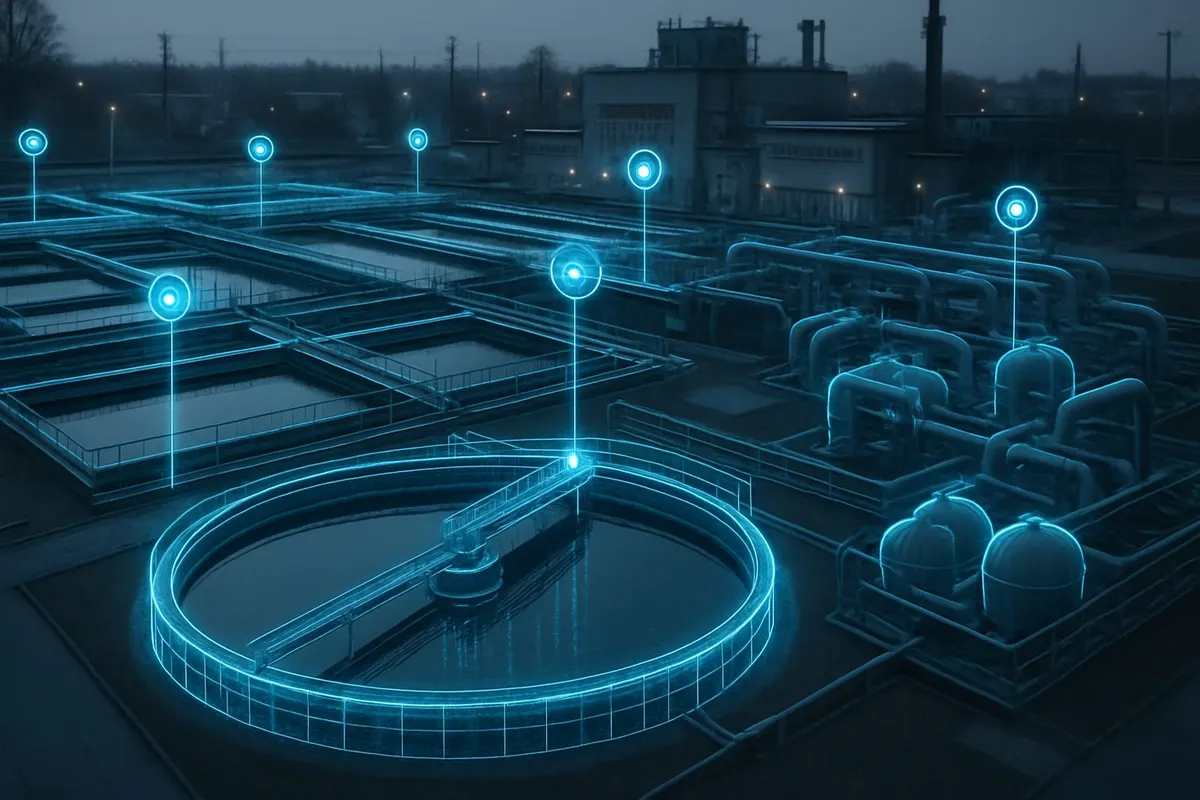
A digital twin for a water treatment plant is a live mathematical model that runs alongside the physical ETP, STP or RO system on real sensor data. Navbharat Water's twins receive readings every 60 seconds and forecast problems such as membrane fouling or aeration failure up to 72 hours ahead, giving operators time to act.
What is a digital twin for a water treatment plant?
A digital twin is a calibrated process model of your specific plant that is fed live data and runs continuously. On Navbharat Water's Smart Water platform, sensors transmit pH, BOD, COD, TSS, flow, temperature, DO, TDS and ORP every 60 seconds, and the model uses those readings to simulate how the plant will behave next.
The word twin matters. A generic simulation of an activated sludge process is useful at design stage; a twin is tuned to your tank volumes, your pumps, your membranes and your influent pattern, and it keeps updating as real data arrives. When the model's prediction and the plant's actual readings start to diverge, that divergence is itself a signal that something in the physical plant has changed.
In practice, a water treatment twin combines three kinds of model:
- Process models: mass balances and established biological kinetics, such as the activated sludge model family published by the International Water Association, describing how organics, nitrogen and solids move through the plant.
- Equipment models: pump curves, blower performance, membrane permeability and pressure drop, used to track asset health over time.
- Data-driven models: machine-learning layers that learn the patterns which precede a failure on your site and flag anomalies the equations alone would miss.
How is a digital twin different from SCADA?
SCADA tells you what the plant is doing now; a digital twin estimates what it will be doing over the next 24–72 hours. SCADA raises an alarm when a reading crosses a set point. The twin warns when the trend in that reading, combined with other parameters, is heading towards a limit, before the alarm would fire.
The two are complementary. SCADA and PLCs remain the control layer that runs pumps, blowers and valves. The twin sits above them as an analytical layer, reading the same data and adding forecasting, what-if simulation and dosing recommendations.
| Aspect | SCADA or manual logs | Digital twin |
|---|---|---|
| Time horizon | Current state | Current state plus a 24–72 hour forecast |
| Alarm logic | Fixed set points | Trends and multi-parameter patterns |
| Chemical dosing | Operator judgement or fixed ratios | Optimal dose calculated in real time from actual load |
| Process upsets | Detected after they happen | Simulated before they occur |
| Who is told | Operator at the HMI | EHS manager and remote support, via WhatsApp and SMS |
How does Navbharat Water's digital twin work, from sensor to alert?
The platform has three layers: OCEMS and process sensors at the plant, an edge gateway that processes and buffers data locally, and a cloud layer where the twin runs. Alerts reach your EHS manager and Navbharat Water's remote support team simultaneously, with a response SLA of under 15 minutes remotely and 4 hours on site.
- Sense: CPCB-approved sensors, calibrated monthly, measure water quality at inlet and outlet points and transmit every 60 seconds.
- Buffer: the edge gateway stores data if the internet connection drops and syncs it automatically when connectivity returns, so the model never works from a gapped record.
- Simulate: the cloud twin runs in parallel with the plant, compares predicted with actual behaviour, and calculates optimal chemical doses.
- Alert: when any parameter trends towards a limit, WhatsApp and SMS alerts go out. For BOOT clients, Navbharat Water operators begin corrective action without waiting for a client call.
Data is retained for 10 years for trend analysis and audits, and the platform carries a 99.5% uptime guarantee. Security follows IEC 62443 for industrial automation and control systems: the SCADA and OCEMS network is segmented from corporate IT and the internet, external access uses encrypted VPN with multi-factor authentication, and data travels over TLS 1.3.
What failures can a digital twin predict?
The most valuable predictions are slow-building failures that give no obvious alarm until late: membrane fouling, which Navbharat Water's twin forecasts up to 72 hours ahead, aeration failure in biological tanks, and pump degradation. In a 12-plant textile cluster, predictive maintenance flagged three pump failures before they occurred.
- Membrane fouling: rising differential pressure and falling normalised flux on RO and UF trains, read against feed quality, show when a clean-in-place will be needed before permeate quality slips.
- Aeration and biology upsets: falling DO at constant blower output, or a shift in ORP, can point to blower wear, diffuser fouling or a shock load reaching the biology.
- Discharge exceedances: when inlet COD or flow rises, the model estimates whether outlet COD, BOD or TSS will approach consent limits hours later.
- Dosing errors: recommendations follow the actual load rather than a fixed ratio, reducing both overdosing and underdosing.
What instrumentation does a plant need for a digital twin?
At minimum, the plant needs continuous flow, pH, COD, TSS and temperature measurement, which is the standard five-sensor OCEMS set, plus DO in aeration tanks and pressure and flow on membrane trains. Navbharat Water's platform monitors up to nine parameters: pH, BOD, COD, TSS, flow, temperature, DO, TDS and ORP.
| Parameter | Where measured | What the twin uses it for |
|---|---|---|
| Flow | Inlet, outlet, reject streams | Hydraulic load, mass balances, recovery |
| pH | Inlet, neutralisation, outlet | Dosing control, biology health |
| COD and BOD | Inlet and outlet | Organic load and removal efficiency |
| TSS | Clarifier and outlet | Solids carry-over and clarifier performance |
| DO | Aeration tanks | Aeration adequacy and blower health |
| TDS | RO feed and permeate | Salt rejection and membrane condition |
| ORP | Biological and disinfection stages | Process state and oxidant residual |
| Temperature | Inlet and aeration | Correcting biological and membrane rates |
Data quality matters more than data volume. A twin fed by an uncalibrated probe will confidently predict the wrong thing, which is why monthly sensor calibration is part of the service rather than an optional extra.
Can a digital twin be added to an existing plant?
Yes. The sensors and gateway are designed for retrofit with minimal process disruption. A standard five-sensor OCEMS retrofit covering pH, COD, flow, TSS and temperature typically takes 2–3 days on a 500 KLD plant, with no production shutdown. The model is then calibrated against the plant's own operating data before its forecasts are relied upon.
Retrofit is usually the practical route. The majority of industrial treatment plants in India still run on manual sampling and daily log books, so exceedances surface only in the monthly lab report and equipment failures can go unnoticed for hours. Adding continuous monitoring solves the visibility problem first, and the twin builds on the same data stream.
What results has a digital twin delivered in practice?
On a multi-site rollout for a Surat-based textile group, 12 ETP and ZLD plants in a Gujarat industrial cluster were connected to one Navbharat Water dashboard. Compliance exceedances fell 94% in the first year, and predictive maintenance flagged three pump failures before they happened, saving ₹15 lakh in unplanned downtime.
The group's EHS head now reviews all 12 sites from a single mobile screen. Navbharat Water monitors 45+ plants live on the same platform across India. Results depend on the starting point: plants with frequent exceedances and reactive maintenance have the most to gain.
What are the limits of a digital twin?
A digital twin is only as reliable as its sensors and its calibration. It cannot compensate for undersized equipment, and it cannot forecast sudden events with no measurable precursor, such as a pipe rupture. Its value lies in the 24–72 hour window it opens for slow-building problems, and in faster, better-informed responses.
- It needs a period of real operating data before forecasts are dependable.
- It does not replace statutory laboratory testing or consent-condition sampling, and it adds value only if someone acts on the alerts, which is why alerts go to both site staff and remote support.
Navbharat Water's digital twin is part of its Smart Water Monitoring solution (/solutions/smart-water), which combines CPCB-approved OCEMS sensors, an edge gateway, cloud simulation and automated alerts for ETP, STP, ZLD and membrane plants, on new builds and as a retrofit.
Frequently asked questions
How far ahead can a digital twin predict problems?
Navbharat Water's digital twin forecasts slow-building problems such as membrane fouling and aeration failure 24–72 hours ahead. The window depends on the failure mode and on how much operating history the model has been calibrated on. Sudden events with no measurable precursor cannot be forecast, but the 60-second data stream means they appear on the dashboard almost immediately.
Does a digital twin replace OCEMS?
No. OCEMS is the regulatory monitoring layer: CPCB-approved sensors that report effluent quality to the CPCB CEMS server. The digital twin uses the same data, together with process sensors, to forecast and optimise. On Navbharat Water's platform both run on one sensor network, so a plant that installs OCEMS for compliance already has most of the data a twin needs.
What happens if the plant's internet connection fails?
The edge gateway at the plant stores data locally and keeps operating the sensors independently of the cloud. When connectivity returns, all stored data syncs automatically, so the record has no gaps. The gateway also drives local alarms and operator displays, so plant operations continue uninterrupted while the connection is down.
Can a digital twin reduce chemical consumption?
It can reduce waste. Instead of dosing coagulant, polyelectrolyte or pH correction chemicals at a fixed ratio, the twin calculates the optimal dose in real time from the actual load reaching the plant. That avoids the overdosing operators often apply as a safety margin, and the underdosing that leads to outlet exceedances when load rises unexpectedly.
Ready to discuss your ZLD requirement?
Navbharat Water engineers have commissioned ZLD plants from 10 KLD to 10 MLD across India. Tell us your inlet profile and compliance target.
Request a Technical Audit