
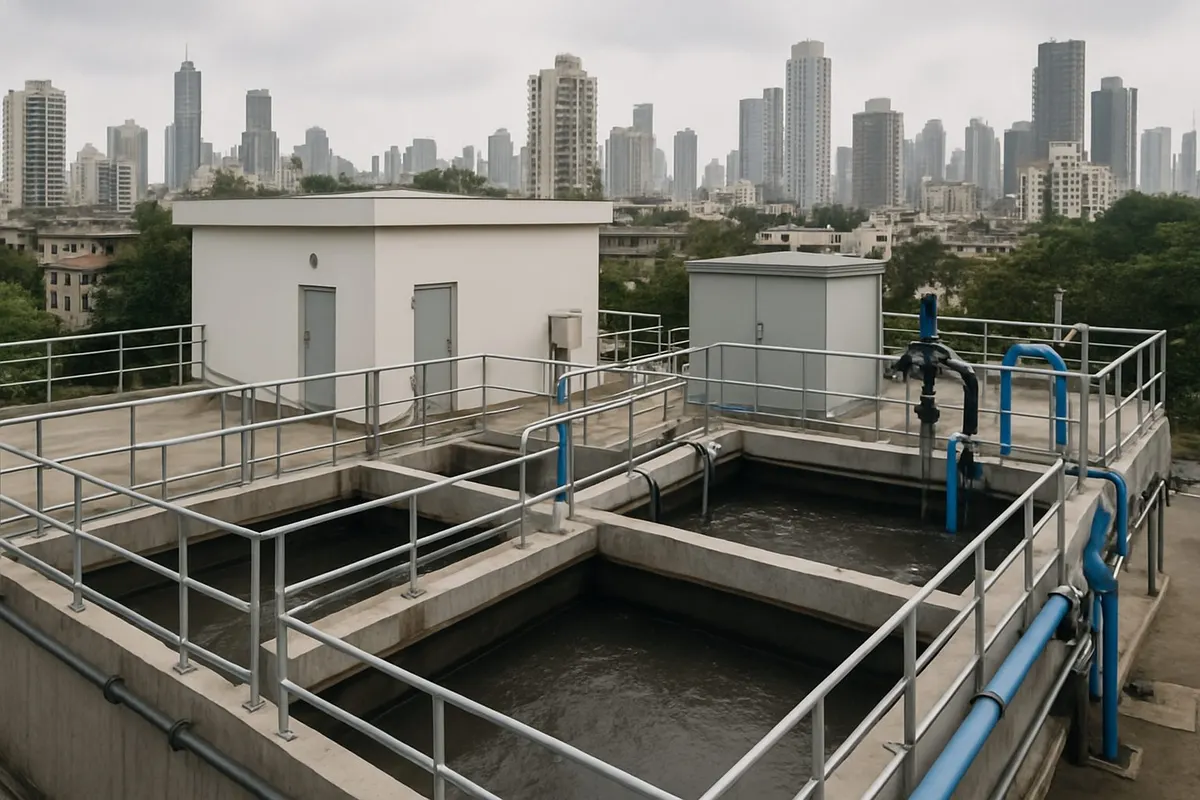
An STP operation and maintenance contract for a Mumbai housing society should cover five things in writing: who runs the plant every day, what maintenance is done and when, which lab tests are taken, which compliance records are kept for the Maharashtra Pollution Control Board (MPCB), and how fast breakdowns are fixed. If any of these is missing from the contract, the society carries that risk itself.
What should an STP O&M contract for a housing society cover?
A complete contract covers operation, maintenance, testing, records and response. Operation means trained operators on the shifts your plant needs. Maintenance means a written schedule for pumps, blowers, diffusers, dosing systems and filters, plus repairs. Testing means regular lab tests of inlet and treated water. Records means the logbooks and registers your consent requires. Response means a stated time to attend breakdowns.
A typical scope list for a society STP includes:
- Shift operators, with daily logs of flow, blower and pump run hours and visual checks.
- Preventive maintenance of pumps, blowers, motors, diffusers, dosing pumps and filters on a written schedule.
- Rotation of duty and standby pumps and blowers, so the standby actually works when needed.
- Routine lab testing of inlet and outlet, with the results kept on file.
- Chemicals and consumables such as chlorine and filter media, either included or billed separately.
- Sludge removal and disposal coordination.
- Membrane cleaning where the plant uses MBR, UF or RO.
- Compliance registers and reports that support the Consent to Operate and its renewal.
Why do society STPs fall out of compliance after the builder hands over?
Most society STPs are designed well and then run by whoever is available. After handover, the plant often passes to a housekeeping or facility team with no process training. Blowers trip, dosing pumps drift, sludge builds up and logbooks go blank, and nobody notices until residents complain about smell or an MPCB inspection exposes the gap.
The plant does not have to be badly built to fail. It only has to be run without a schedule. Odour is often the first sign: our guide on how to fix STP odour permanently explains how low dissolved oxygen and old sludge turn a working plant septic. Pump failures are the second: a duty pump that runs every day while the standby sits idle wears out early, and the standby is often found not working on the day it is needed.
Which records should the contractor keep for MPCB?
The contractor should keep daily operating logs, lab test results, maintenance and breakdown records, and chemical and sludge registers, and give the committee a regular summary. STPs in Maharashtra must obtain consent from the MPCB and be run according to the conditions in that consent, so these records are the evidence that the plant is being run as the consent requires.
Outlet quality is the number that matters most. The 2017 sewage treatment plant standards cap outlet BOD at 30 mg/L, or 20 mg/L in metro cities and state capitals, and the NGT or the State Pollution Control Board may set stricter limits. Your own Consent to Operate states the limits that apply to your plant. Ask the contractor to report results against those limits, not just as raw numbers.
How is an STP O&M contract priced?
STP O&M is priced either as a fixed monthly fee or as a rate per kilolitre treated, and it should be quoted after a site audit. A fixed monthly fee suits most housing society STPs because flows are fairly steady. The quote depends on plant capacity, technology, the number of shifts, whether chemicals and spares are included, sludge disposal and the condition of the plant.
Be careful with quotes given without a site visit. A contractor who has not seen the plant cannot know whether the blowers, diffusers or membranes need work, and the gap usually comes back as extra bills later. Navbharat Water quotes after the audit rather than from a rate card.
What should the contract say about breakdowns and response times?
The contract should state how quickly the contractor will attend a breakdown, which spares are held on site, and who pays for which repairs. The AMC on our service models page commits to emergency corrective response within 24 hours. Whatever the number in your contract, it should be written down, not promised on a call.
Also agree which outlet parameters are tracked, how often they are tested, and what the contractor does when a result is out of limits. A good contract treats a failed lab result as a trigger for action, not just a line in a report.
How do you take over an STP the builder installed?
Start with an audit, not a contract. Engineers check the tanks and civil condition, pumps, blowers and motors, instruments and control panels, and the treatment process, and sample the inlet and outlet. The result is a rectification list that separates what must be fixed before handover from what can be planned later. Once the plant meets its baseline, the O&M contract starts.
Common findings in society plants are failed or undersized aeration, dosing systems out of calibration, accumulated sludge, a standby pump that does not run and missing records. Navbharat Water takes over plants of any make and age; see our AMC and O&M service for how the takeover works.
Can remote monitoring reduce the committee's risk?
Yes. Remote monitoring lets the committee see whether the plant is running without visiting the basement. AquaVigil shows flow, outlet quality, dissolved oxygen and pump status on a live dashboard and sends WhatsApp alerts when something goes wrong, such as a pump trip or low dissolved oxygen. The Watch tier costs ₹4,999 per plant per month, exclusive of GST.
Monitoring does not replace the operator. It makes the operator and the contractor accountable, because the committee and the contractor see the same data.
Checklist before you sign
- The contract names the service level: AMC, comprehensive O&M or operator deployment.
- Shift coverage and operator qualifications are written down.
- There is a preventive maintenance schedule with duty and standby rotation.
- Lab testing frequency and the outlet limits to test against are stated.
- The records the contractor keeps for MPCB are listed.
- Breakdown response time and on-site spares are agreed.
- It is clear what is included in the fee: chemicals, consumables, spares and sludge disposal.
- The contractor has audited the plant before quoting.
Frequently asked questions
Is the builder responsible for the STP after handover?
Once the building is handed over, the society runs the premises, so day-to-day operation of the STP and compliance with the consent conditions sit with the managing committee. Ask the builder for the consent documents, drawings, equipment manuals and the last lab reports at handover, because the O&M contractor will need all of them.
Can a contractor take over an STP built by another company?
Yes. Navbharat Water takes over STPs of any make and age. The takeover starts with a site audit, then a rectification list, then repairs to bring the plant back to its design outlet, and only then does the O&M contract start.
How is STP O&M for a society priced?
Either as a fixed monthly fee or as a rate per kilolitre treated, quoted after a site audit. The fee depends on plant capacity, technology, shift coverage, whether chemicals and spares are included and the condition of the plant. Navbharat Water does not publish rate cards.
What outlet quality must a Mumbai society STP meet?
The 2017 sewage treatment plant standards cap outlet BOD at 30 mg/L, or 20 mg/L in metro cities and state capitals, and the NGT or the State Pollution Control Board may set stricter limits. The limits in your own Consent to Operate are the ones that apply to your plant.
Do we still need an operator if we install remote monitoring?
Yes. Remote monitoring shows flow, outlet quality, dissolved oxygen and equipment status, and sends alerts, but someone still has to act on them. It makes the operator and the contractor accountable; it does not replace them.