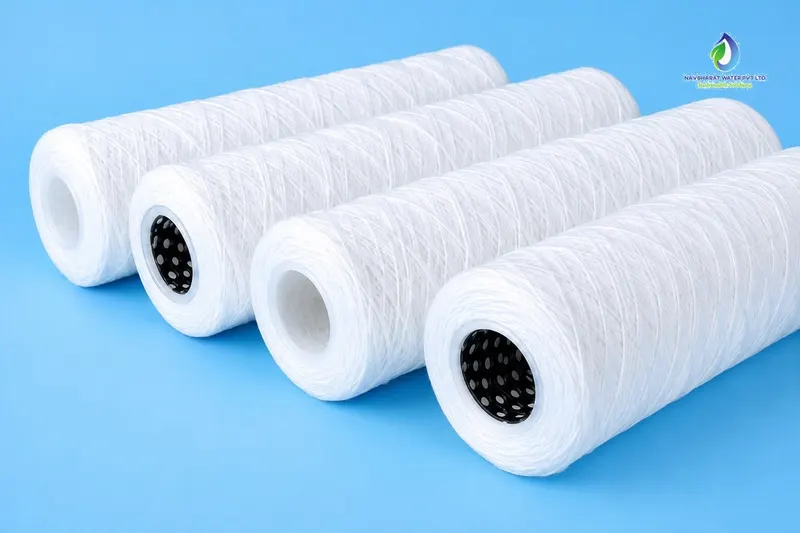
NWPL Wire Wound Filter Cartridge
Filter Cartridges Manufacturer in India · Mumbai HQ, ships across India
Honeycomb structure · Deep filtration · RO pre-filtration
Textile fiber tightly wound on porous framework in honeycomb structure for deep filtration. Used in RO pre-filtration, sterile water, ultra-pure water, mechanical/cutting/heavy oil filtration, and industrial water.
Specifications
| Type | Wire wound (string wound) cartridge |
|---|---|
| Structure | Honeycomb — outer thin, inner dense deep filtration |
| Filter Lengths | 10″, 20″, 30″, 40″ |
| Brand | Navbharat Water (NWPL) |
| Country of Origin | Made in India |
| Certification | ISO 9001:2015 |
Where it's used
- RO Pre-filtration
- Drinking Water
- Electronics High-Purity Water
- Pharmaceutical
- Food, Wine & Beverage
- Industrial & Process Water
Related solutions
What it is and when to use it
The NWPL wire-wound (string-wound) cartridge is made by winding textile fibre tightly around a porous core in a honeycomb pattern. Use it for depth filtration in RO pre-filtration, drinking water and ultra-pure water pre-filtration, and for oils and industrial fluids, where a robust wound structure performs well.
The winding pattern creates a honeycomb structure that is thinner outside and denser inside, so particles are captured progressively through the depth of the cartridge. The rigid core and wound construction make it robust for viscous fluids and variable flows.
The NWPL catalogue lists a wide range of duties: pre-filtration of drinking water, RO pre-filtration, pre-filtration of sterile and ultra-pure water, filtration of mechanical, cutting, heavy and fuel oils, industrial water and electroplating solutions. Cartridges are available in 10″, 20″, 30″ and 40″ lengths. Confirm fibre and core material when the liquid is chemically aggressive or hot.
Use it for
- Filtration of mechanical, cutting, heavy and fuel oils
- RO pre-filtration and drinking-water sediment removal
- Electroplating solutions and industrial process water
- Viscous or variable-flow duties that need a robust cartridge
How to choose
- Specify the liquid (water, oil or chemical) so fibre and core materials can be matched
- Choose the micron rating according to the required protection
- Match the length (10″–40″) and end type to your housing
- Allow for viscosity when sizing cartridge count and flow per cartridge
- Monitor differential pressure to set change-out intervals
Frequently asked questions
What is a wire-wound filter cartridge made of?
Despite the name, a wire-wound cartridge is usually wound with textile fibre, not metal wire. The fibre is wound tightly around a porous core in a honeycomb pattern that is thinner outside and denser inside, giving depth filtration. Fibre and core materials can be selected to suit water, oils or chemical solutions.
Is a wire-wound cartridge suitable for oil filtration?
Yes. The NWPL catalogue lists mechanical oil, cutting oil, heavy oil and fuel oil among typical wire-wound applications. The wound structure and rigid core handle viscous fluids well. Viscosity reduces flow per cartridge, so size the housing for the actual oil and temperature, and confirm material compatibility.
Wire-wound or PP spun: which cartridge is better for RO pre-filtration?
Both are used. PP spun cartridges are the economical standard for clean municipal or borewell water. Wire-wound cartridges are robust and handle varying flow and viscous or oily contamination well. The choice depends on your feed water, the required micron rating and the change-out frequency you are aiming for.
Technically reviewed by Prashant Dwivedi, Co-Founder & Director ·