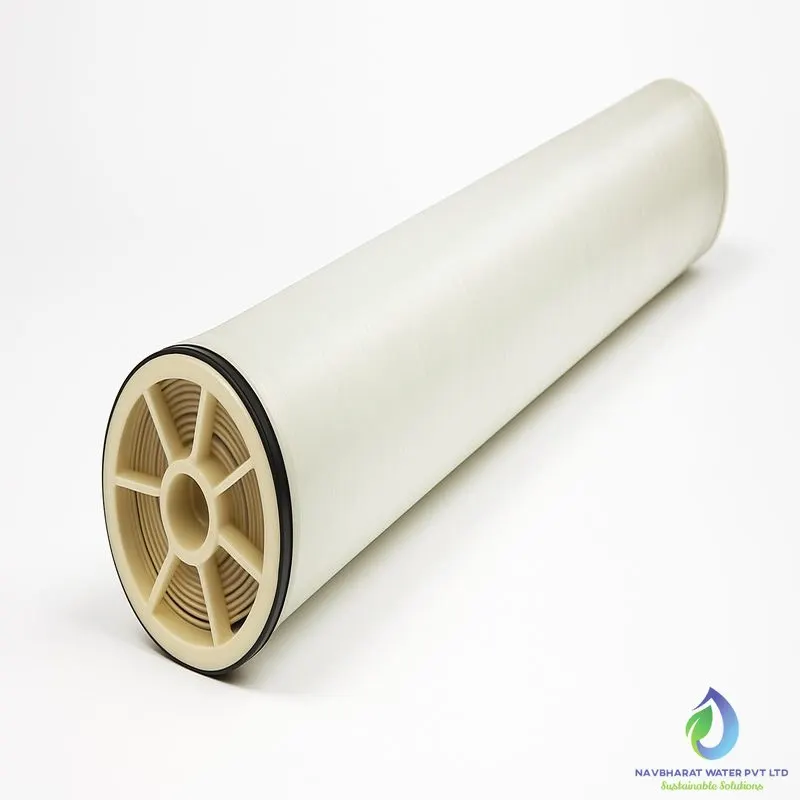
NWPL BW-4040/8040 RO Membrane (Brackish Water)
RO Membranes Manufacturer in India · Mumbai HQ, ships across India
99.5–99.8% rejection · 2000 ppm · 45 °C max · 600 psi · pH 3–10
Polyamide composite spiral-wound RO element for brackish water up to 2000 ppm TDS. Models: BW-4040-HR (99.7%), BW-4040-HF (99.5%), BW-4040-FR (99.8%). Max operating pressure 600 psi (4.14 MPa). For industrial and commercial RO systems.
Specifications
| Membrane Type | Polyamide composite, spiral wound |
|---|---|
| Models | BW-4040-HR / HF / FR · BW-8040-HR / HF / FR |
| Salt Rejection | 99.5–99.8% |
| Max Operating Pressure | 600 psi (4.14 MPa) |
| Max Feed Temperature | 45 °C |
| pH Range (operation) | 3–10 |
| Brand | Navbharat Water (NWPL) |
| Country of Origin | Made in India |
| Certification | ISO 9001:2015 |
Where it's used
- Industrial RO Systems
- Commercial RO Systems
- Boiler Feed Water
- Process Water
- Wastewater Reuse
Related solutions
What it is and when to use it
The NWPL BW-4040/8040 is a polyamide composite spiral-wound RO membrane for brackish water, tested on 2000 ppm feed at 225 psi with 99.5–99.8% salt rejection. Use it in industrial and commercial RO plants treating borewell, surface or reuse water with salinity above typical tap water.
The BW series comes in HR, HF and FR grades. In the 4040 size (90 ft² / 8.4 m²), the HR delivers 2,400 GPD at 99.7% rejection, the HF 2,700 GPD at 99.5% and the FR 1,900 GPD at 99.8%. The 8040 size delivers 11,000 GPD (HR, 99.7%), 12,000 GPD (HF, 99.5%), and 9,600–11,500 GPD at 99.8% across the 365, 400 and 440 FR variants. Single-element flow may vary within 15%.
Per the manual, operating limits are 600 psi maximum pressure, 45 °C feed temperature, SDI15 5, turbidity 1 NTU, free chlorine 0.1 mg/L and 15 psi pressure drop per element. The operating pH range is 3–10, and cleaning pH is 2–12. Maximum feed flow is 14 GPM for the 4040 and 85 GPM for the 8040.
Use it for
- Brackish borewell or surface water with salinity above tap-water levels
- Boiler feed and process water in industrial plants
- Wastewater reuse downstream of UF or tertiary treatment
- Replacing elements in existing 4-inch or 8-inch RO pressure vessels
How to choose
- Choose 4040 or 8040 to match your pressure vessels and plant capacity
- Choose HR, HF or FR by balancing permeate quality against flow and energy
- Check feed water against the SDI15 5, 1 NTU and 0.1 mg/L free-chlorine limits
- Run a system projection with your full water analysis to set recovery, flux and antiscalant
- Plan pre-treatment (cartridge filtration, dechlorination, antiscalant) before commissioning
Frequently asked questions
What is the difference between BW-4040-HR, HF and FR membranes?
They trade rejection against flow. On the 2000 ppm, 225 psi test, the BW-4040-HR gives 2,400 GPD at 99.7% rejection, the HF gives the most water at 2,700 GPD and 99.5%, and the FR gives 1,900 GPD with the highest rejection at 99.8%. The right grade depends on your permeate quality target and feed water.
What feed water quality does the BW membrane require?
The NWPL BW manual sets a maximum SDI15 of 5, turbidity of 1 NTU and free chlorine of 0.1 mg/L, with feed temperature up to 45 °C and operating pH 3–10. Staying within these limits usually means cartridge filtration, dechlorination with SMBS and an antiscalant dose ahead of the membranes.
Can NWPL BW membranes replace other brands in my RO plant?
BW elements come in the standard 4040 and 8040 formats, 40 inches (1,016 mm) long with 3.9-inch and 7.9-inch diameters, so they fit standard 4-inch and 8-inch pressure vessels. Before replacing, share your current element data and water analysis so we can check that flow and rejection match your design.
Technically reviewed by Prashant Dwivedi, Co-Founder & Director ·