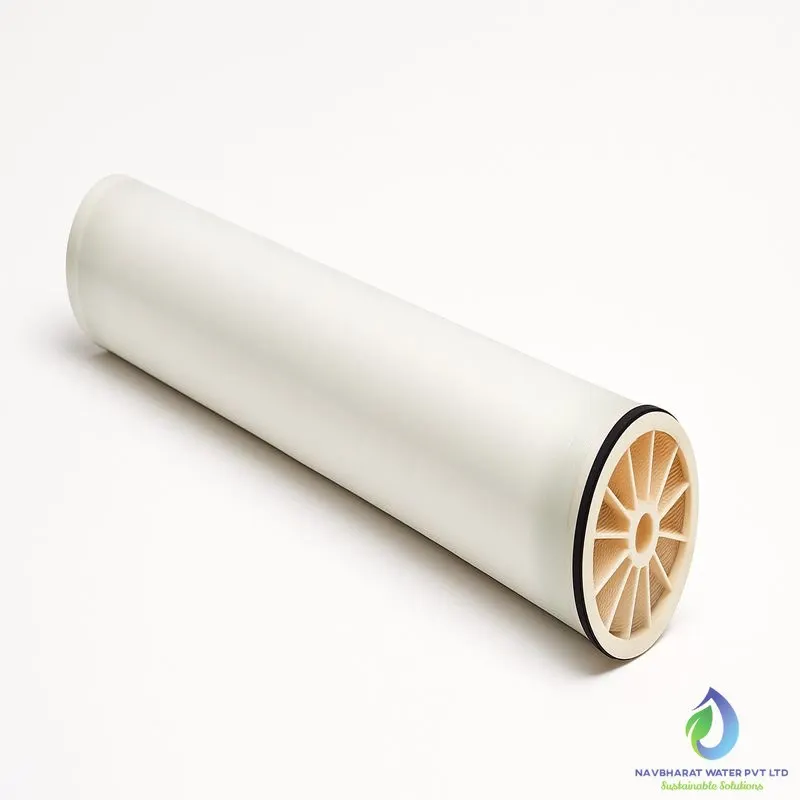
NWPL TW-4040/8040 RO Membrane (Tap Water)
RO Membranes Manufacturer in India · Mumbai HQ, ships across India
99.0–99.5% rejection · 1500 ppm · 45 °C max · 600 psi · pH 3–10
Polyamide composite RO membrane optimised for 1500 ppm tap water. Models: TW-4040-HR (99.3%), TW-4040-HF (99.0%), TW-4040-FR (99.5%). Operating pH 3–10. For drinking water purification, boiler recharge, and process water applications.
Specifications
| Membrane Type | Polyamide composite, spiral wound |
|---|---|
| Models | TW-4040-HR / HF / FR · TW-8040-HR / HF / FR |
| Salt Rejection | 99.0–99.5% |
| Max Operating Pressure | 600 psi (4.14 MPa) |
| Max Feed Temperature | 45 °C |
| pH Range (operation) | 3–10 |
| Brand | Navbharat Water (NWPL) |
| Country of Origin | Made in India |
| Certification | ISO 9001:2015 |
Where it's used
- Drinking Water Purification
- Boiler Recharge Water
- Process Water
- Direct Drinking Water Production
Related solutions
What it is and when to use it
The NWPL TW-4040/8040 is a low-pressure polyamide composite RO membrane for tap and low-salinity water, tested on 1500 ppm feed at 150 psi with 99.0–99.5% salt rejection. Use it for drinking water, direct drinking water production, boiler recharge and process water, where lower pressure means lower energy use.
Because TW elements are tested at 150 psi rather than the 225 psi used for BW, they suit feeds with lower dissolved solids, where high-pressure operation is unnecessary. In the 4040 size (90 ft² / 8.4 m²), the TW-4040-HR delivers 2,400 GPD at 99.3%, the HF 2,700 GPD at 99.0% and the FR 1,900 GPD at 99.5%. The TW-8040 delivers 10,500 GPD (HR, 99.3%), 11,000 GPD (HF, 99.0%) and 10,500 GPD (FR, 365 ft², 99.5%).
The operating limits are the same as for the rest of the range: 600 psi maximum pressure, 45 °C maximum feed temperature, SDI15 5, turbidity 1 NTU, free chlorine 0.1 mg/L and 15 psi pressure drop per element. For higher-salinity feeds, choose the BW series.
Use it for
- Municipal or low-TDS tap water for drinking-water purification
- Direct drinking water and packaged water production
- Boiler recharge and utility water in commercial buildings
- Low-energy RO where feed salinity is modest
How to choose
- Confirm feed TDS suits a tap-water element; use BW for more saline feeds
- Choose HR, HF or FR by balancing rejection against permeate flow
- Select 4040 or 8040 to match vessel size and plant output
- Ensure municipal chlorine is removed to below 0.1 mg/L before the membranes
- Confirm recovery and array design with a projection based on your water analysis
Frequently asked questions
When should I choose a TW membrane instead of a BW membrane?
Choose TW when the feed is municipal or low-salinity water. TW elements are tested at 150 psi on 1500 ppm feed, while BW elements are tested at 225 psi on 2000 ppm feed. The lower test pressure means TW can produce water with less pump energy on clean, low-TDS feeds. For higher salinity, BW is the better fit.
Do I need to remove chlorine before a TW membrane?
Yes. Municipal water is usually chlorinated, and the NWPL TW manual limits free chlorine to 0.1 mg/L because chlorine damages polyamide membranes. Dechlorinate with an activated carbon filter or an SMBS dose upstream of the cartridge filter, and check residual chlorine regularly.
What permeate flow does the TW-8040 produce?
On the standard test (1500 ppm, 150 psi, 25 °C, 15% recovery), the TW-8040-HR delivers 10,500 GPD at 99.3% rejection, the HF 11,000 GPD at 99.0% and the FR 10,500 GPD at 99.5%. Actual flow in your plant depends on temperature, feed quality, recovery and pressure.
Technically reviewed by Prashant Dwivedi, Co-Founder & Director ·