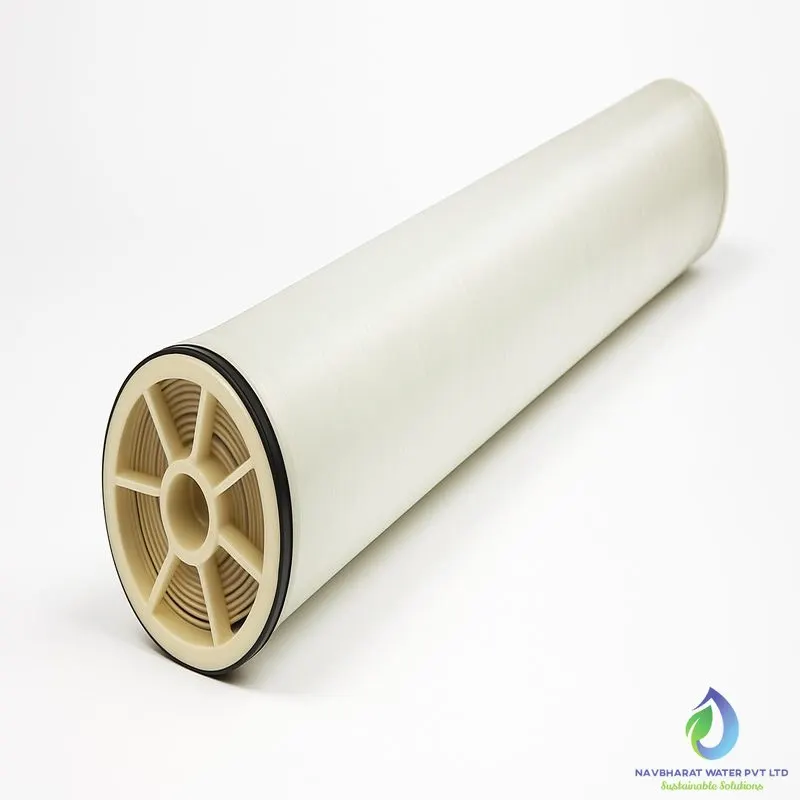
NWPL SW-4040/8040 RO Membrane (Sea Water)
RO Membranes Manufacturer in India · Mumbai HQ, ships across India
99.7–99.85% rejection · Seawater · 45 °C max · 1200 psi · pH 3–10
High-pressure polyamide composite RO element for seawater desalination and high-TDS feeds. Models: SW-4040-HR/HF/FR (1600–1900 GPD) and SW-8040-HR/HF/FR (6000–11000 GPD). Salt rejection up to 99.85%.
Specifications
| Membrane Type | Polyamide composite, spiral wound |
|---|---|
| Models | SW-4040-HR / HF / FR · SW-8040-HR / HF / FR |
| Flow (SW-4040) | 1600–1900 GPD @ 800 psi test |
| Flow (SW-8040) | 6000–11000 GPD @ 800 psi test |
| Salt Rejection | 99.7–99.85% |
| Max Operating Pressure | 1200 psi (8.3 MPa) |
| Max Feed Temperature | 45 °C |
| pH Range (operation) | 3–10 |
| Brand | Navbharat Water (NWPL) |
| Country of Origin | Made in India |
| Certification | ISO 9001:2015 |
Where it's used
- Seawater Desalination
- Ultra-Pure Water Production
- Landfill Leachate Discharge
- Wastewater Decolorization & COD Removal
Related solutions
What it is and when to use it
The NWPL SW-4040/8040 is a high-pressure polyamide composite RO membrane for seawater and high-TDS feeds, rated to 1200 psi with 99.7–99.85% salt rejection. Use it for seawater desalination and demanding industrial duties such as ultra-pure water, landfill leachate and high-COD wastewater treatment.
SW elements are built to operate at the much higher pressure needed to overcome the osmotic pressure of seawater. The manual rates them to 1200 psi, double the 600 psi of the BW and TW series, and tests them at 800 psi. In the 4040 size (85 ft² / 7.9 m²), the HR and FR produce 1,600 GPD at 99.8% and the HF 1,900 GPD at 99.7%.
The SW-8040 produces 7,500 GPD (HR, 400 ft², 99.8%), 11,000 GPD (HF, 99.7%) and 6,000 GPD (FR, 365 ft², 99.85%). Feed limits are SDI15 5, turbidity 1 NTU, free chlorine 0.1 mg/L, 45 °C maximum temperature and 15 psi pressure drop per element. Seawater intakes generally need robust pre-treatment such as UF to meet these limits consistently.
Use it for
- Seawater desalination for industrial or municipal supply
- High-TDS brackish or reject streams beyond BW capability
- Landfill leachate and high-COD wastewater polishing
- Ultra-pure water systems that need very high rejection
How to choose
- Confirm that high-pressure pumps, vessels and piping are rated for SW operating pressure
- Choose HR, HF or FR from the permeate quality and flow targets
- Design pre-treatment, often UF, to hold SDI15 below 5 and turbidity below 1 NTU
- Use a membrane projection to set recovery, flux and energy recovery
- Select an antiscalant and cleaning regime suited to high-TDS feeds
Frequently asked questions
What pressure does the NWPL SW seawater membrane operate at?
The SW series is rated for a maximum operating pressure of 1200 psi (8.3 MPa), and its performance is tested at 800 psi. That is double the 600 psi limit of the BW and TW elements, reflecting the higher pressure needed to desalinate seawater. Pumps, vessels and piping must all be rated to match.
Which SW model gives the highest salt rejection?
The SW-8040-FR has the highest rated rejection at 99.85%, producing 6,000 GPD on the standard test. The SW-8040-HR gives 7,500 GPD at 99.8%, and the SW-8040-HF gives 11,000 GPD at 99.7%. In the 4040 size, the HR and FR give 99.8% and the HF 99.7%.
What pre-treatment does a seawater RO membrane need?
Seawater carries suspended solids, organics and biological matter, so feed must be treated to meet the manual limits of SDI15 5, turbidity 1 NTU and free chlorine 0.1 mg/L. A typical train uses UF or media filtration, cartridge filters, SMBS for dechlorination and an antiscalant ahead of the high-pressure pump.
Technically reviewed by Prashant Dwivedi, Co-Founder & Director ·