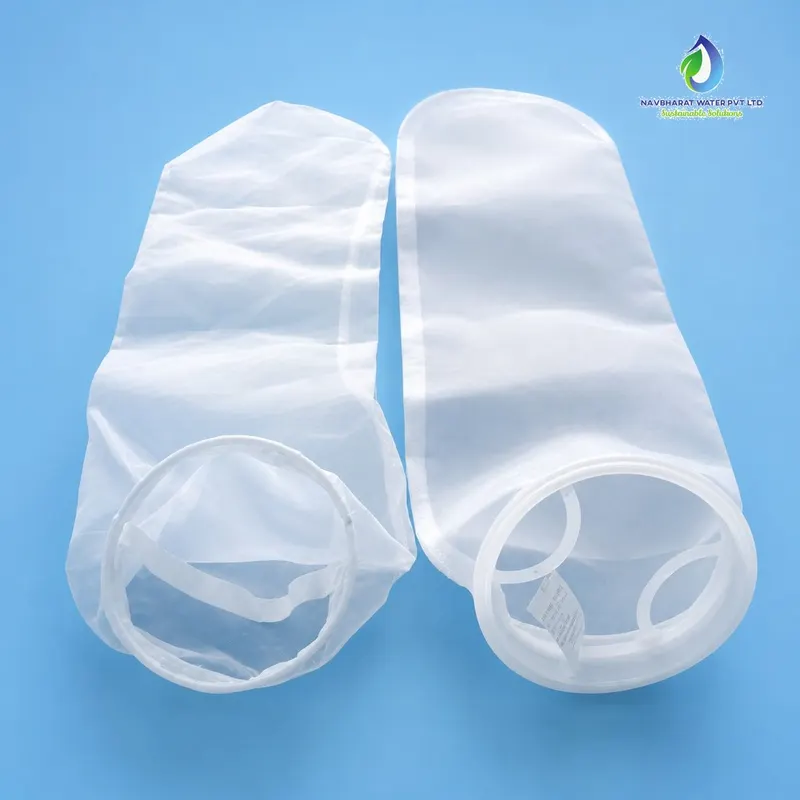
NWPL NMO Nylon Filter Bag
Filter Bags Manufacturer in India · Mumbai HQ, ships across India
10–800 mesh · Nylon mono/multi-filament · Repeatable cleaning
Nylon monofilament and multifilament construction for absolute precision filtration. Good deformation resistance and wear resistance. Suitable for repeated chemical cleaning.
Specifications
| Material | Nylon mono-filament & multi-filament |
|---|---|
| Filtration Precision | 10–800 mesh |
| Bag Sizes | Size 1 (7″×16″) · Size 2 (7″×32″) |
| Features | Absolute precision filtration, wear resistant, reusable after cleaning |
| Brand | Navbharat Water (NWPL) |
| Country of Origin | Made in India |
| Certification | ISO 9001:2015 |
Where it's used
- Water & Wastewater Treatment
- Pharmacy
- Food & Beverages
- Paints, Coatings & Glue
- Petrochemical Engineering
- Electronic Technology
- Metal Processing
- Automobile Making
Related solutions
What it is and when to use it
The NWPL NMO nylon filter bag uses woven nylon monofilament or multifilament mesh, rated from 10 to 800 mesh. Use it when you need surface filtration with a precise, repeatable opening and a bag that can be cleaned and reused rather than discarded after each change.
Unlike felt bags, which trap particles through their depth, a nylon mesh bag captures solids on its surface. The woven opening is uniform, so the cut point is sharp and predictable. Because the solids sit on the surface, they can be washed off, and the catalogue notes the bag tolerates repeated cleaning with good resistance to wear and deformation.
Mesh count is the number of openings per linear inch, so a higher mesh number means a finer opening. Mesh bags have lower dirt-holding capacity than felt, so they suit streams with modest solids loads or relatively large, hard particles. Nylon is tough and abrasion resistant but less tolerant of strong mineral acids than polypropylene.
Use it for
- Where a reusable, washable bag lowers consumable cost
- Removing hard, well-defined particles such as scale, sand or grit
- Paint, coating and electrophoresis filtration where a clean cut point is needed
- Protective strainer-style duties ahead of pumps, nozzles or finer filters
How to choose
- Specify the mesh count (10–800) from the smallest particle that must be stopped
- Choose monofilament for easy cleaning and multifilament where finer retention is needed
- Check liquid pH; for strong mineral acids, consider PP bags instead
- Compare solids loading with the lower dirt-holding capacity of a surface-filtration mesh
- Plan a cleaning routine and inspect the mesh for damage before each reuse
Frequently asked questions
What is the difference between mesh and micron ratings?
Mesh counts the openings per linear inch of woven fabric, so a higher mesh means a finer opening. Micron is a direct measure of the particle size a medium is rated to retain. Nylon mesh bags are specified by mesh (10–800 for NMO bags), while felt bags such as PP and PE are specified in micron.
Can the NMO nylon filter bag be cleaned and reused?
Yes. Because nylon mesh captures solids on its surface rather than inside the fabric, the cake can be washed off and the bag reused, and the NMO bag is built for repeated cleaning. The number of reuse cycles depends on the solids, cleaning method and handling, so inspect the seams and mesh before putting a cleaned bag back in service.
When is a nylon mesh bag a better choice than a felt bag?
A nylon mesh bag is better when you need a precise cut point, when particles are hard and well defined, or when reusing bags saves money. A felt bag holds more dirt because it filters through its depth, so it is usually better for high solids loads, soft or gel-like particles, and fine micron ratings.
Technically reviewed by Prashant Dwivedi, Co-Founder & Director ·