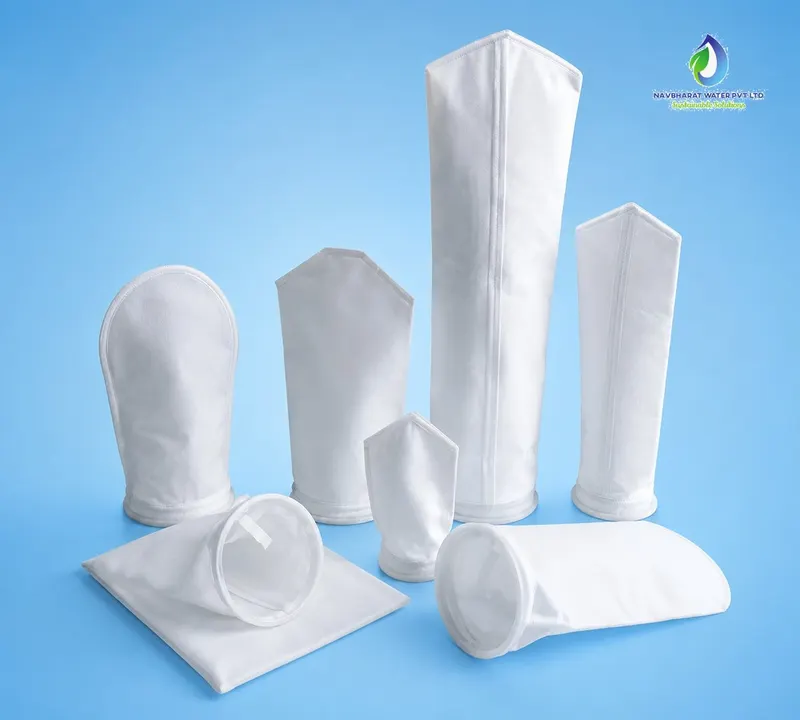
NWPL PE Filter Bag
Filter Bags Manufacturer in India · Mumbai HQ, ships across India
1–300 micron · PE Polyester · 130–150 °C
Polyester filament fiber with excellent mechanical strength. Food grade application rated. Handles higher temperatures than PP — suitable for hot liquid filtration.
Specifications
| Material | Polyester (PE) filament fiber |
|---|---|
| Filtration Precision | 1–300 micron |
| Max Temperature | 130–150 °C |
| Bag Sizes | Size 1 (7″×16″) · Size 2 (7″×32″) |
| Features | High mechanical strength, food grade application |
| Brand | Navbharat Water (NWPL) |
| Country of Origin | Made in India |
| Certification | ISO 9001:2015 |
Where it's used
- Water & Wastewater Treatment
- Pharmacy
- Food & Beverages
- Paints, Coatings & Glue
- Petrochemical Engineering
- Electronic Technology
- Metal Processing
- Automobile Making
Related solutions
What it is and when to use it
The NWPL PE filter bag is made from polyester filament fibre and rated for 130–150 °C, well above polypropylene. Use it for hot liquids, food-grade duties and applications where the bag must stand up to mechanical stress without tearing or stretching.
Polyester filament gives the bag high tensile strength and dimensional stability, so it holds its shape under pressure surges and repeated handling. The higher temperature rating makes it the practical choice for hot process water, edible oils, syrups, coatings and hot-melt applications described in the NWPL catalogue.
The trade-off is chemistry. Polyester is generally less resistant to strong alkalis than polypropylene, and hot alkaline conditions can degrade the fibre, so high-pH washes and caustic streams are better served by PP or the TPF bag. For neutral and mildly acidic liquids, and for most organic solvents, polyester performs well. PE bags are offered from 1 to 300 micron in Size 1 (7″×16″) and Size 2 (7″×32″).
Use it for
- Hot liquids above the PP limit, up to the 130–150 °C rating
- Food and beverage filtration where a food-grade bag is specified
- Paints, coatings, resins and adhesives where mechanical strength matters
- Duties with pressure fluctuation where a PP bag may stretch
How to choose
- Check the operating and cleaning temperatures; above 150 °C, look at the TPF high-temperature bag
- Avoid PE for strongly alkaline streams; confirm the pH and any caustic cleaning step
- Match micron rating to the contaminant; for gels or soft particles, a slightly coarser rating often avoids premature blinding
- Choose Size 1 or Size 2 according to housing length and required filter area
- Tell us about food-contact requirements so we can confirm the right bag construction
Frequently asked questions
What temperature can the NWPL PE filter bag handle?
The NWPL PE filter bag is rated for 130–150 °C, compared with 90–100 °C for the PP bag. This makes it suitable for hot process liquids and hot food and beverage streams. For continuous service above 150 °C, or where strong acids or oxidisers are also present, the TPF high-temperature bag (196–260 °C) is the better fit.
Is the PE filter bag suitable for alkaline or caustic liquids?
Generally no. Polyester can hydrolyse in strong alkaline conditions, particularly when hot, which weakens the fibre over time. For caustic streams or high-pH cleaning solutions, a polypropylene bag is usually the safer choice. Send us the liquid composition, pH and temperature and we will recommend the material that will last.
Why choose a polyester bag for paints, resins and edible oils?
These liquids are often handled warm and can be viscous, which puts mechanical load on the bag. Polyester filament has high strength and holds its shape, so it resists stretching and bursting under those conditions. It is also rated for food-grade application, which matters for edible oils, syrups and beverage filtration.
Technically reviewed by Prashant Dwivedi, Co-Founder & Director ·